 reva
revaWhat Is a Good Profit Margin for Reselling?
The honest answer: margin alone cannot tell you if a flip was good.
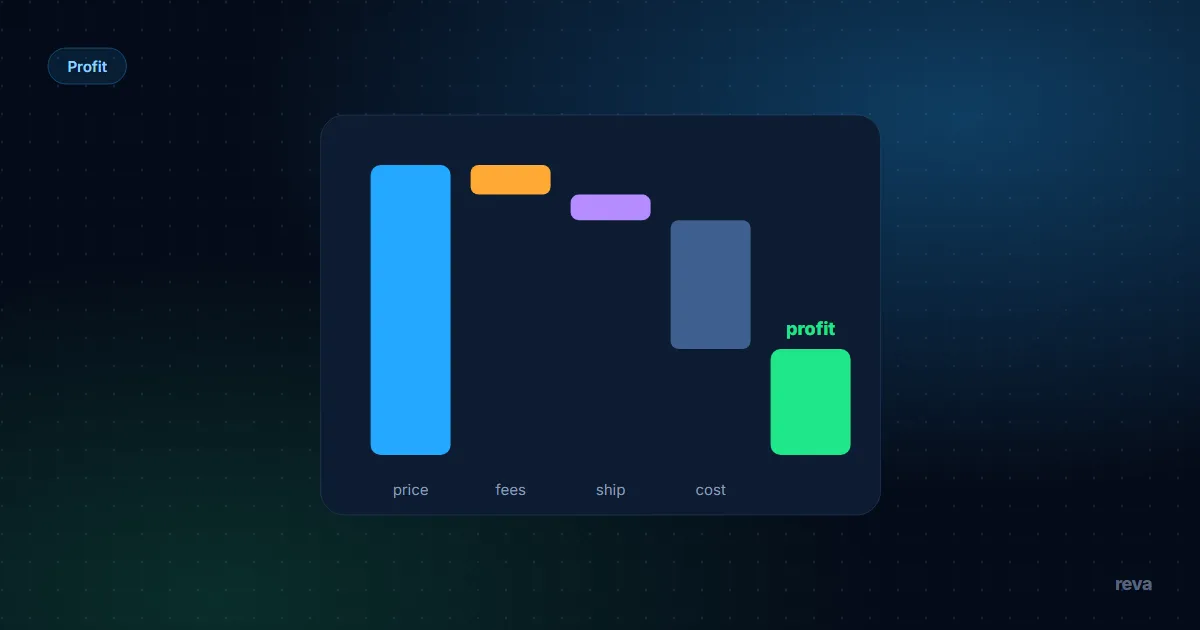
- No universal margin target exists for reselling: public averages for EU resale are not credible, so set two personal lines from your own last twenty flips.
- Margin per item must clear your fixed work: one floor number in zł, applied before you buy.
- Margin per day is the fair way to compare a fast small flip with a slow big one — it prices the time your capital spends in stock.
- Gross margin flatters; net margin after fees, shipping and supplies is the number that pays for the next buy.
- A single percentage cannot say whether a flip was good — money, time and hidden costs decide that together.
The honest answer to what is a good profit margin for reselling: no single number exists. There are no trustworthy public averages for EU resale, and the same percentage can be excellent on one flip and pointless on another — margin alone says nothing about the money tied up, the time it sat, or what fees took. Below: the three numbers that do compare flips, and how to set your two personal targets from them.
One worked example runs through the whole page: a jacket bought for 100 zł, sold for 180 zł.
Why "50% margin" answers nothing on its own
A percentage hides its base. Fifty percent on a 40 zł lamp is 20 zł; fifty percent on a 600 zł console is 300 zł — different money, risk and work. The figure is slippery too: most sellers quoting a margin mean sale price minus item cost, before fees, shipping and supplies. So a stranger's margin tells you almost nothing — you need the base and the cost line.
Margin per item: your floor for taking a flip
For the jacket: 180 − 100 = 80 zł, or 44% of the sale price. The useful version is not the percentage but a floor in złoty. Every flip needs photos, a listing, messages and packing — roughly the same hour whether the item sells for 130 or 1,300. If your floor is "at least 30 zł net per item", an 80 zł flip passes twice over; a 12 zł flip fails before the percentage comes up.
Margin per day: comparing a fast flip with a slow one
The jacket held 40 days: 80 ÷ 40 = 2 zł per day. Second flip: a mug bought for 10 zł, sold for 30 zł — 20 zł margin in 5 days. That is 4 zł per day, twice the jacket's rate. Margin per day prices your capital's time — the only fair way to compare the mug with the jacket. It needs your own records of listed and sale dates; the metric behind it is days to sell.
Margin after hidden costs: the honest version
Say the jacket's marketplace takes 12 zł in fees, you cover 9 zł of shipping, and packing materials cost 4 zł. Net margin: 80 − 25 = 55 zł, or 31% of the sale price instead of 44%. The full inventory of easy-to-forget costs is in hidden costs of reselling. Run your own numbers here:
Margin and return on money invested rank deals differently when buy prices vary — see ROI vs margin, and run that version in the ROI calculator.
What is a good profit margin for reselling, then
Your answer is two lines, from your own records rather than anyone's average:
- A net floor per item — example: 30 zł and 25% of the sale price. Below it, walk away, whatever the category.
- A target per day — example: 3 zł per day held. This is what makes small fast flips legitimate and slow big ones accountable.
Twenty recorded flips give you enough history to set both — the resale profit calculator and the habits in the resale profit guide get you there. Revisit the lines quarterly: raise them if your sourcing improved; if you set them from hope rather than history, reset them to true. What they protect in the background — money not stuck in stock — is the subject of reseller cash flow.
Related guides
Frequently asked questions
What is a good profit margin for reselling?
How much profit should I make per item?
Is a higher margin always better?
How do fees change my real margin?
See price estimates on live finds
This calculator needs your inputs. Scout estimates fair value, a fast-sell price and demand for the finds it shows you. Estimates, not guarantees.
reva estimates prices from public listings. Estimates, not guarantees.Keep reading

Work out what a flip really earns: cost of goods, marketplace and buyer fees, shipping, returns, promotions, ROI vs margin and tracking profit per item.
25 min read
ROI, profit margin and markup use the same numbers but answer different questions. Formulas, one worked flip showing all three and when resellers use each.
5 min read
Free resale profit calculator: enter buy price, sale price, marketplace fees, shipping and extras to see net profit, margin and ROI in zł, euros or pounds.
7 min read