 reva
revaQuick Sale Price Calculator
A price aimed at selling fast, checked against your break-even.
- The calculator uses only prices you enter: a fast-sell price from the lower quarter of comparable live asks, and a fair value from comparable items that left the market.
- To find the lower quarter, sort your comparable asks from cheapest, count them, and take the listing at position count ÷ 4, rounded up.
- Profit at each price = price − price × fee % − shipping you pay − your cost. Put packaging and any fixed per-order fee into Your cost.
- A negative Profit at fast price means the quick-sale price is below break-even. Break-even = (your cost + shipping you pay) ÷ (1 − fee %). Example: a 118 zł cost at Allegro Lokalnie's 7.9% needs about 128.12 zł.
- Every output is an estimate built from other listings, not a promise that the item sells at that price.
A quick sale price calculator gives you a price aimed at selling fast and shows whether that price still leaves a profit. Enter the lower quarter of the comparable asking prices you found, your fair value estimate, your cost, the marketplace fee and any shipping you pay. You get a fast-sell price, a balanced price and the profit at each, so a quick sale never becomes a loss you didn't notice.
The calculator has no market data of its own. Every result is an estimate built from your numbers.
How to use the quick sale price calculator
- Fair value: the median last price of comparable items that left the marketplace. Finding sold comps shows how to collect them.
- Cheapest-quarter asking price of live listings: worked out in the next section.
- Your cost: purchase price, delivery you paid when buying, packaging and any fixed per-order fee. There is no separate field for these; adding them here gives the same profit.
- Marketplace fee: the percentage taken from you as seller. Allegro's fee page for Allegro Lokalnie (checked 13 September 2026) lists 7.9% of item value for Kup teraz and auctions, 4.9% in Elektronika, and 0 zł for local listings. Vinted's UK and Poland price lists show no seller commission, so a private seller enters 0.
- Shipping you pay: only postage that comes out of your money; 0 if the buyer pays.
Entering comparable asking prices
The calculator takes one asking price, so sort your list first. Search your exact item and note the price of every live listing that matches:
- Same brand, model, size and condition grade
- Single items, not bundles
- Shipped listings if you plan to ship
- Same marketplace and currency
Example: you are selling a used winter jacket and find 10 comparable listings at 95, 110, 120, 130, 140, 150, 160, 175, 190 and 230 zł. 10 ÷ 4 = 2.5, rounded up to 3, so the lower-quarter ask is 120 zł.
Why the lower quarter, not the lowest
The cheapest ask is the least reliable price on your list. It may hide a flaw, a wrong size or collection-only delivery. The lower quarter keeps you among the cheapest options without letting one outlier set your price: 120 zł rather than 95 zł in the jacket example.
- If the cheapest ask sits far below the lower-quarter ask, open that listing and find the reason before you price.
- If several asks share the cheapest price, that cluster is the market, not an outlier.
- If comparable items rarely leave the market, a lower price may not buy speed. Check resale demand first.
Checking against break-even
This is exactly what the calculator computes:
It does not print a break-even price. Read the sign instead: if Profit at fast price is negative, your fast-sell price is below break-even.
For the exact floor, work it out by hand:
In the second example, 118 ÷ 0.921 ≈ 128.12 zł. The break-even price calculator adds fields for fixed fees, other costs and a target profit.
Quick sale vs fair value vs maximum
The fast-sell price is the bottom rung of a five-level ladder; the calculator shows the bottom three.
- You need the cash or space now: fast sell, if its profit is positive.
- You want speed but your comparables are thin: balanced.
- Comparable items leave the market steadily and you can wait: fair value.
At a 118 zł cost only fair value clears break-even, so the real choice is waiting at 135 zł or taking a loss. Fast sale or max profit covers all five levels, and the resale pricing guide sets out the whole method.
When not to price for speed
- Profit at fast price is negative and you are not short of cash or space
- You have four or fewer close asks, so the lower quarter is simply the cheapest listing
- Comparable items rarely leave the market
- Buyers in your category usually send offers
- The item's season has not started, such as a winter jacket in summer
If offers are the norm, price for offers with headroom above your floor. If a live listing is stalling, lower the price one level at a time and stop at fast sell, or at break-even if that is higher.
Frequently asked questions
Will pricing at the quick-sale level guarantee a sale?
How many comparable listings should I enter?
Should I just match the cheapest listing?
What do I do if the quick-sale price shows a loss?
Sources
- Allegro Help: Fees on Allegro Lokalnie checked 13 Sept 2026
- Vinted Poland price list (cennik) checked 13 Sept 2026
- Vinted UK price list checked 13 Sept 2026
- Vinted Poland Terms (version in force, with update notice) checked 13 Sept 2026
- Vinted UK Terms and Conditions (version in force, with update notice) checked 13 Sept 2026
- Value Added Resource: Vinted Europe terms update, October 2026 checked 13 Sept 2026
See price estimates on live finds
This calculator needs your inputs. Scout estimates fair value, a fast-sell price and demand for the finds it shows you. Estimates, not guarantees.
reva estimates prices from public listings. Estimates, not guarantees.Keep reading

How to price used items for resale: comps from sold and live listings, condition, price levels from fast sale to max profit, markdowns, offers and bundles.
21 min read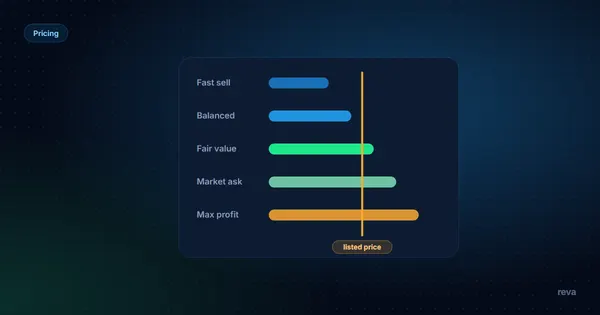
Five price levels, from fast sell to max profit, what each is based on and when to choose it depending on cash needs, demand and how long you can wait.
8 min read
Price listings with room for offers: setting an offer floor, how much headroom to add, responding to lowballs, and when to refuse offers on fast-moving items.
4 min read