 reva
revaThe Complete Resale Pricing Guide
A price is an estimate with a range. Here is how to build it, choose a level and adjust it over time.
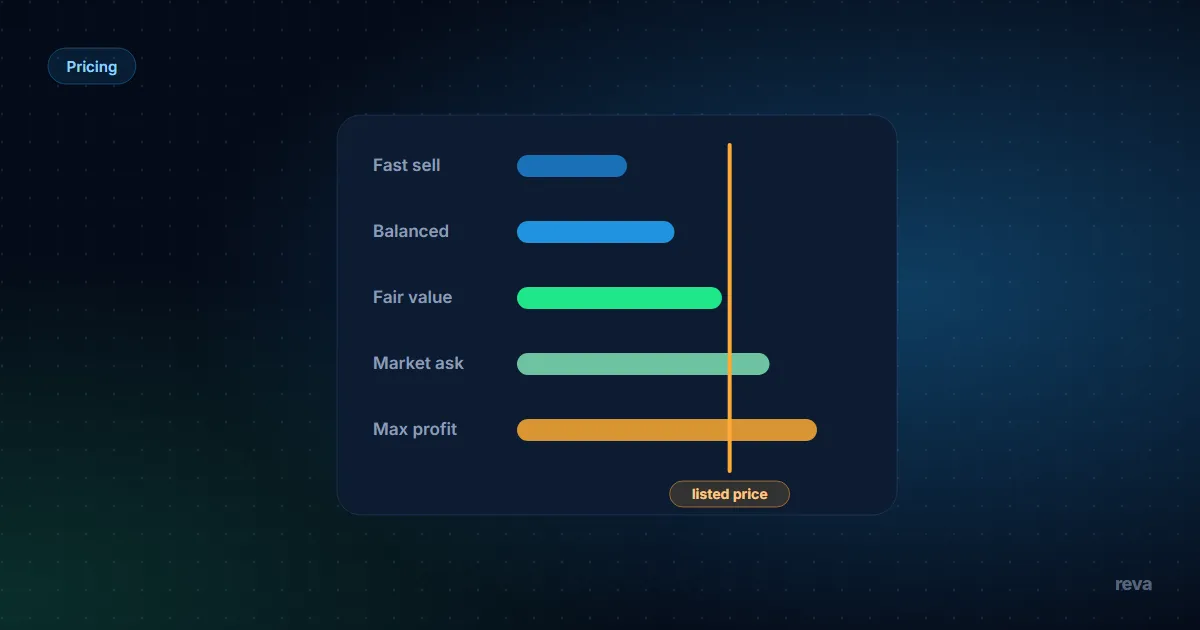
- Price an item as a ladder of five levels, from fast sell (near the cheapest quarter of comparable asks) to max profit (capped at 1.25 × fair value), not as one number.
- Fair value is the median of comparable items that left the market. Live asking prices usually sit higher: they show your competition, not what buyers pay.
- Confidence comes from the number of close, recent comps. In this guide's example, removing one outlier moves a four-comp median by 10 zł and a fourteen-comp median not at all.
- Vinted's own guidance, checked 13 Sept 2026: New/Like new 60–80%, Very good 40–60%, Good/Satisfactory 20–40% of retail. Use it as a sanity check when comps are thin.
- Mark down one ladder level at a time, stop at fast sell, and edit the price instead of deleting and relisting (in OLX's free and limited categories, a relist within 14 days counts as a duplicate).
- How to price items for resale: a range, not a single price
- Sources of price evidence: exits, live asks, official guidance
- Items that left the market
- Live asking prices
- Official guidance
- Finding comparable items: brand, model, size, condition
- How many comps you need and how confident to be
- Condition and photos: adjusting for the item in front of you
- The price ladder: fast sell, balanced, fair value, market ask, max profit
- Choosing a level for your goal and cash needs
- Offers, bundles and psychological pricing
- Offers
- Bundles
- Psychological pricing
- Markdowns: when and how much to lower
- Category differences: sneakers, phones, bags, watches, vintage
- Common pricing mistakes
To price items for resale, collect comparable items that recently left the market and comparable listings still for sale, then adjust for the condition of your own item. The result is a range, not one number: five price levels from fast sell to max profit, plus a note of how confident your evidence lets you be. Where you list inside that range depends on how strong the comps are and how soon you need the cash.
This guide shows how to price items for resale step by step on Vinted, OLX and Allegro Lokalnie, using a method that doesn't depend on a sold filter. It covers where price evidence comes from, how many comps you need, how condition moves the number, how to build the ladder and pick a level, and how offers, bundles, markdowns and categories change the answer. Marketplace facts are sourced and were checked on 13 September 2026. Every other number is marked as an example.
How to price items for resale: a range, not a single price
"What is it worth?" assumes there is one answer. On second-hand marketplaces there isn't. The same model in the same size leaves the market at different prices in the same month, because each listing has different photos, wording, seller history, shipping options and timing. A single figure hides that spread, and the spread is what tells you how to list.
A range with a stated confidence gives you three prices a single figure can't:
- The floor. Below it you are paying for speed with margin.
- The centre. Where comparable items typically stop being available.
- The ceiling. Above it the item mostly sits.
Vinted frames pricing as a trade-off too. Its help page "Choosing the price for your item" says that "setting a price that's lower than our catalogue average price might help you sell faster". Price also affects visibility: Vinted's "Our platform" page lists price among the item attributes it uses to rank listings in feeds and search, next to upload time and brand. How much weight price carries is not published.
Decision rule: if you can't say how many comparable items your price is based on, you don't have a price yet. You have a guess.
- 1Collect compsSame brand, model, size and condition: recent exits and live asks
- 2Judge confidenceCount close matches and check how far apart their prices are
- 3Adjust for your itemCondition, flaws, completeness and photo quality
- 4Build the ladderFast sell, balanced, fair value, market ask, max profit
- 5Pick a levelMatch it to demand and how soon you need the money
- 6Review with evidenceViews, favourites and offers decide the next step down
Sources of price evidence: exits, live asks, official guidance
You have three kinds of evidence. Each answers a different question, and each has a blind spot.
| Evidence | What it tells you | Main weakness |
|---|---|---|
| Items that left the market | Roughly where buyers stopped searching for that item | A listing can disappear because it sold, was removed or was reserved off-platform |
| Live asking prices | What you compete against today | Includes overpriced listings that will never sell |
| Official guidance, such as Vinted's percentage of retail | A sanity check when comps are thin | Broad ranges, not specific to your item |
And when there are no comps at all — a rare or one-off item — pricing an item with no comparables lists the honest fallbacks in order of reliability.
Items that left the market
Where a marketplace publishes completed sales, a sold filter gives you real transaction prices. That is why most English comps guides are written around eBay. Vinted, OLX and Allegro Lokalnie work differently. Vinted's pricing help page tells sellers to "search the catalogue for similar items to see how other members price them" and says nothing about a sold filter. Some third-party blogs say you can filter by sold on Vinted and others say you can't. We could not confirm either on Vinted's official pages, so don't build your method on it.
What you can do is follow comparable listings and note the last price when each one disappears. That is a "left the market" price. Often it is a sale, but a seller may also have deleted the listing or agreed a deal elsewhere. The median of these exits is your best estimate of fair value. Give recent exits more weight than old ones, because demand moves with season and trend.
The routine for collecting exits on each of the three marketplaces is in how to find sold comps on Vinted, OLX and Allegro Lokalnie. How fair value is defined, and how it sits among the other price levels, is on choosing a price level.
Live asking prices
Live asks show your competition. They usually sit above the exits, because the cheapest listings disappear first and overpriced ones stay behind. If you sort a search by price and take the middle, you are measuring the survivors.
- Left the market (count per 20 zł band)
- Live asks (count per 20 zł band)
- Median exit: 260 zł
- Median ask: 290 zł
Decision rules:
- If the exit median and the ask median are close, the market is liquid, and pricing near the ask is realistic.
- If asks sit well above exits, most sellers are overpricing. Price off the exits.
- If you have asks but almost no exits, demand is weak or the item is new to the market. Lower your confidence and lean towards the fast-sell end. How to check resale demand before you buy shows how to read those signals.
Official guidance
Of the official Vinted, OLX and Allegro Lokalnie pages we reviewed for this guide, only Vinted's pricing help page gives a percentage-of-retail guide. The ranges are in the condition section below. Use them to catch a price that is far off, not to set it to the złoty.
The same page notes that "a discount may help you sell items that do not fit the current season". So check when your exits happened: summer exits for a winter coat are weak evidence for a price in spring.
Finding comparable items: brand, model, size, condition
A comp is only useful if a buyer would treat it as a substitute for your item. Check these in order and drop any listing that fails an early one.
- Same brand and the same model or line, not just the same category
- Same size (for shoes and clothing) or the same storage and variant (for electronics)
- Same condition grade as the marketplace defines it, with similar visible wear
- Same completeness: box, charger, dust bag, receipts, tags
- A single item, not part of a bundle or lot
- Priced in the same currency and market, so no cross-border listings mixed into zł comps
- Recent: prefer exits from the last few weeks over last season's
Search with brand and model in the query, then apply the size and condition filters before you read any prices. Don't trust titles alone. Open each listing and check the photos against the stated condition. A "Very good" pair with a visible sole split is not a Very good comp.
On OLX and Allegro Lokalnie, check whether a listing is shipped or collection only. Allegro's fee page lists a 0 zł sale fee for local listings (ogłoszenia lokalne) and a percentage fee on "Kup teraz" and auctions. Sellers who pay no fee can accept a lower price than sellers who do, so group comps by listing type where you can.
Worked example. Say you want to sell a used pair of Nike Dunk Low trainers, size 42, in Very good condition. Over a few weeks you note 14 comparable pairs that left the market. Their last prices are 210, 225, 235, 240, 250, 255, 260, 260, 265, 270, 280, 290, 300 and 320 zł. You also see 12 live listings, and their median ask is 290 zł. These are the numbers in the chart above and the ladder below.
How many comps you need and how confident to be
None of the marketplace pages we reviewed gives a minimum number of comps. The reason more is better is arithmetic: with a handful of prices, one odd listing moves the median a lot.
Confidence depends on two things: how many close matches you have and how similar they really are. Twenty loose matches can mislead you more than eight exact ones.
Set your own thresholds and write them down, so the same evidence always gets the same confidence. Example thresholds you could adopt: fewer than 5 close comps means low confidence, 5 to 9 is medium, and 10 or more recent, close comps is high.
Then check the spread. Sort your exits and look at the middle half. In the Dunk example it runs from about 240 to 280 zł around a 260 zł median, so the market agrees with itself. If the middle half ran from 150 to 350 zł, you could reasonably downgrade even 14 comps to medium confidence and look for a hidden difference, such as mixed sizes or conditions.
Condition and photos: adjusting for the item in front of you
Comps give you a market price for a condition grade. Your item then has to earn its place inside that grade.
Vinted's help page "Choosing the price for your item" (UK and .com versions, checked 13 September 2026) gives this guide:
| Vinted condition | Suggested price, as a share of the retail price |
|---|---|
| New / Like new | 60%–80% |
| Very good | 40%–60% |
| Good / Satisfactory | 20%–40% |
Example: if the Dunk pair cost 500 zł new, Vinted's Very good range puts it at 200–300 zł. The comp-based fair value of 260 zł sits inside that range, so the two sources agree.
Decision rule: if comps and the percentage range disagree, trust the comps when your confidence is medium or high, and the range when it is low. A comp median outside the range often means your comps are in a different condition or are a different model.
Condition is also a claim you are making. Vinted's help page on significantly not as described items includes undisclosed damage, incorrect size, wrong colour and different main materials, but not minor differences such as lighting. On OLX, Pakiet Ochronny covers an item that doesn't match the listing, including undisclosed damage or a "new" item showing wear (Annex 8, checked 13 September 2026). Grading up to reach a higher band buys you a claim risk, not extra margin.
Photos move you within the band. Vinted's Catalogue Rules require real photos, so no stock images and nothing taken from ads. Clear photos of a small flaw let you price near the middle of the band honestly. Dark or partial photos put your listing up against better-presented comps at the same price.
Example adjustment: your pair has a scuff on the toe box that most comps don't show. Price it one ladder level lower than a clean pair, and show the scuff in the second photo. How condition changes resale price goes through grading and claim risk category by category.
The price ladder: fast sell, balanced, fair value, market ask, max profit
A ladder turns your evidence into five usable prices. Each level comes from a named piece of evidence, so you can explain every number to yourself:
- Fast sell: near the cheapest quarter of comparable asking prices.
- Balanced: between fast sell and fair value.
- Fair value: the median of comparable items that left the market.
- Market ask: the median of comparable live listings.
- Max profit: the top of the realistic range, never above fair value × 1.25.
The cap on max profit stops the ladder drifting towards the long tail of unrealistic asks. For the Dunk example, fair value is 260 zł, so max profit can't go above 260 × 1.25 = 325 zł. The rule works the same in any currency: example in euro, a €60 fair value caps max profit at €75.
On Vinted, the buyer does not see your price alone. Vinted's Poland price list says the Buyer Protection fee is "usually" 5% + 2.90 zł. It varies with item characteristics, order value and order type, and is shown at checkout. Example: on a 260 zł item that is 13 zł + 2.90 zł, so the buyer pays about 275.90 zł before shipping. Compare your item price with other item prices, not with the total a buyer sees.
Vinted has announced updated Terms taking effect on 5 October 2026 in Germany and France and on 8 October 2026 in the UK, US and Poland. Press coverage reports that the Buyer Protection fee will be renamed "Vinted fee". Check the price list again after those dates.
The reasoning behind each level, and how to choose between them for a given item, is on choosing between the five price levels. Why this guide says "left the market" rather than "sold" is explained on the data and pricing methodology page.
Choosing a level for your goal and cash needs
The ladder tells you what is possible. Your situation decides which level to use.
| Your situation | Start at | Why |
|---|---|---|
| You need the money this week, or the item is bulky to store | Fast sell | You compete with the cheapest listings and accept a known discount |
| Plenty of identical listings, steady exits | Balanced or fair value | Buyers have choices, so headroom mostly costs you views |
| Few identical listings, high confidence, no rush | Market ask | You can wait for the buyer who wants this exact item |
| Rare item, exact comps, strong demand | Max profit | Only when evidence supports it, and never above the 1.25 × cap |
| Low confidence in your comps | Balanced | A mistake costs less in either direction |
The calculator below takes your fast-sell and fair-value numbers and shows what the bottom three levels leave you after costs.
What the calculator computes:
Its balanced price is the midpoint. Treat that as one reasonable choice between the two levels, not a fixed rule.
Worked example with the Dunk numbers, a purchase cost of 120 zł and shipping paid by the buyer:
- Vinted. The price lists show no seller commission, so enter 0%. Profit is 110 zł at fast sell (230 zł), 125 zł at balanced (245 zł) and 140 zł at fair value (260 zł).
- Allegro Lokalnie "Kup teraz". Allegro's fee page, checked 13 September 2026, lists 7.9% of item value (4.9% for Elektronika), and the 7.9% applies to a pair of trainers. A 2026 third-party article reports a different electronics rate and new category caps; Allegro's own page showed neither on 13 September 2026, so check it before you rely on the electronics figure. Profit is about 91.83 zł at fast sell, 105.65 zł at balanced and 119.46 zł at fair value.
- In both cases the fast-sell price is about 11.5% below fair value.
Weigh that discount against time. If a fast sale frees 120 zł to buy the next item a few weeks sooner, giving up 30 zł can be the better deal. The quick sale price calculator page covers what to do when a fast price drops below break-even.
Offers, bundles and psychological pricing
Offers
Headroom is the gap between your listing price and the lowest offer you will accept. Set that floor before you list. It can never sit below the higher of your fast-sell price and your break-even after fees. When exits are steady, you can set it higher, at fair value.
Example: list the Dunks at market ask (290 zł) with a floor at fair value (260 zł). That is 30 zł of room to negotiate, and any accepted offer still lands at or above what similar pairs usually leave the market at.
Decision rules:
- Many identical listings: list near fair value and keep headroom small. A high start costs views while cheaper pairs sell.
- Few identical listings and steady exits: list at market ask and let offers come to you.
- An offer below your floor: counter at the floor or decline. Don't split the difference.
How to price for offers ties the size of the headroom to demand.
Bundles
Bundles have platform rules that affect pricing:
- Vinted Catalogue Rules: a bundle listing must be labelled as a bundle with one total price, and items in it cannot also be listed separately.
- Vinted Pro: bundles are allowed, but "bundle discounts cannot be applied".
- Vinted buyer fee: the price list says the Buyer Protection fee varies with order type, single item or bundle.
- OLX Terms: a listing must say whether it is a single item, multiple units or a set.
Example: three T-shirts, each with a fair value of 40 zł, add up to 120 zł. A bundle at 105 zł gives the buyer a clear saving on one parcel. It works for you only if 35 zł per shirt is still above your per-item floor. How to price bundles and lots covers the per-item floor maths.
Psychological pricing
Some sellers use charm prices, for example 249 zł instead of 250 zł. We have not found published marketplace data on Vinted, OLX or Allegro Lokalnie showing how much they change results. Use them as a tie-breaker once you have chosen a ladder level. Moving a whole level matters far more than the last złoty.
Markdowns: when and how much to lower
Lower the price one ladder level at a time, not by a random percentage. Each step should answer something the listing has told you.
| Signal after a reasonable wait | Likely cause | Action |
|---|---|---|
| Very few views | Search and presentation: title, category, first photo | Fix those before touching the price |
| Views, few favourites | Price or photos compare badly with similar listings | Step down one level, or retake the first photo |
| Favourites, no offers | Interested buyers think it's slightly too high | Step down one level |
| Offers below your floor | Price is fine, buyers are testing | Hold, counter at the floor |
Example schedule for the Dunks: list at market ask (290 zł). With no offers after two weeks, move to fair value (260 zł). After two more weeks, move to balanced (245 zł). The last step is fast sell (230 zł). The intervals are an illustration, not a platform rule. Stop at fast sell. Below it, compare the price with your break-even and consider a bundle or another marketplace instead.
Platform mechanics that shape how you mark down:
- Vinted: its pricing help page (376, checked 13 September 2026) says you can change the price by editing your published listing. The Terms forbid deleting and re-listing the same item multiple times. During a Bump you can lower the price but not raise it, and the Bump cost stays the same (help page 340). Some third-party blogs claim that a cut of 5% or more notifies buyers who favourited the item. Vinted's help pages we read don't say so, so don't plan around it.
- OLX: listings run for 30 days. In free and limited categories, ending a listing and adding the same item again within 14 days counts as a duplicate under the Terms (effective 27 April 2026). Edit the price instead.
- Allegro Lokalnie: auctions run for 7 days, so an auction's end is a natural point to review before relisting at a lower level.
A full schedule tied to demand, with a stop point before dead stock, is on when to lower your price. If you sell mainly on Vinted, how to price items on Vinted applies the same method to Vinted's data limits and fee display.
Category differences: sneakers, phones, bags, watches, vintage
The method stays the same. What changes by category is what counts as a comp and which official reference points exist.
| Category | What makes a comp | Sourced reference points (checked 13 Sept 2026) |
|---|---|---|
| Sneakers | Model, colourway, exact size, sole and heel wear, box | eBay UK authenticates trainers mandatorily from £200. eBay.de authenticates sneakers from €200. |
| Phones | Model, storage, battery health, lock status, cosmetic grade | Vinted Electronics Verification: 20 zł (PL), £5 (UK). Allegro Lokalnie: 4.9% for Elektronika vs the standard 7.9%. |
| Designer bags | Model, size, hardware, serials, receipts, dust bag | Vinted Item Verification: 45 zł (PL), £10 (UK). eBay UK authenticates handbags mandatorily from £200. |
| Watches | Reference number, papers, box, service history | Chrono24 charges private sellers 6.5% commission. eBay UK and eBay.de authenticate watches mandatorily from £1,500 / €1,500. |
| Vintage clothing | Label era, material, measurements, not only brand | Etsy accepts an item as vintage only if it is at least 20 years old |
What that means for pricing:
- Sneakers. Size is the first filter, because the same model can behave like a different product one size away. Above the eBay authentication thresholds, a buyer can get a checked pair elsewhere. If your price is in that territory, show proof of authenticity in the listing or expect buyers to compare you with that option. See how to price used sneakers.
- Phones. Compare storage and battery health before price. Swappie, which buys iPhones from sellers in Poland among other countries, lets you lock a quote for 14 days. That makes it a quick floor check: if your fast-sell profit after fees is below what the buyback quote leaves you, the buyback may be the better route. See reselling used iPhones in Europe.
- Designer bags. Documentation is part of the item. A bag with receipts and serials and a bag without them are different comps. Buyers on Vinted can pay for Item Verification on top of your price, so a bag with papers gives them less reason to. See designer bag resale.
- Watches. Exact reference numbers make comps precise, and papers and box change the price level. Compare your net after a 6.5% Chrono24 commission with your net elsewhere before choosing a channel. See the watch resale guide.
- Vintage. Exact comps rarely exist. Match on era, fabric and measured size, accept lower confidence, and price from the balanced level. See how to price vintage clothing.
The same comp rules apply to categories not covered in the table: for singles, graded cards and lots see reselling trading cards, and for devices beyond phones see reselling used electronics.
Common pricing mistakes
Check your listing against this list before you publish.
- Pricing from live asks only: the median ask runs above what items leave the market at
- Pricing from what you paid ("I paid 150 zł, so I need 300 zł"): buyers don't see your cost
- Mixing sizes, conditions or bundles into your comps
- Comparing your item price with the total a Vinted buyer pays including the Buyer Protection fee
- Grading condition up to reach a higher band, then facing a not-as-described claim
- Leaving fees out of your floor, for example 7.9% on an Allegro Lokalnie "Kup teraz" sale
- Cutting by a random percentage every few days instead of stepping down one level on evidence
- Deleting and relisting instead of editing the price (a duplicate within 14 days in OLX's free and limited categories, and restricted in Vinted's Terms)
- Listing above max profit because one high comp exists
- Treating any estimate, your own or a tool's, as a promise of the sale price
A last test before you publish: name the ladder level your price sits at, the number of comps behind it, and your floor. If you can answer all three, the price is defensible even if the item takes longer to sell than you'd like.
Frequently asked questions
How do I work out what my item is worth?
Should I price high and accept offers?
How often should I lower my price?
Can a price estimate be guaranteed?
Why do similar items have such different prices?
Sources
- Vinted UK Help: Choosing the price for your item checked 13 Sept 2026
- Vinted Help (vinted.com): Choosing the price for your item checked 13 Sept 2026
- Vinted UK: Our platform (ranking factors, §8) checked 13 Sept 2026
- Vinted UK Help: What is an item Bump checked 13 Sept 2026
- Vinted Poland price list (cennik) checked 13 Sept 2026
- Vinted UK price list checked 13 Sept 2026
- Vinted UK Help: Significantly not as described items checked 13 Sept 2026
- Vinted UK Catalogue Rules checked 13 Sept 2026
- Vinted UK Help: Vinted Pro (bundles) checked 13 Sept 2026
- Vinted UK Terms and Conditions (version in force, with update notice) checked 13 Sept 2026
- Vinted Poland Terms (version in force, with update notice) checked 13 Sept 2026
- Vinted Germany Terms (version in force, with update notice) checked 13 Sept 2026
- Vinted France Terms (version in force, with update notice) checked 13 Sept 2026
- Value Added Resource: Vinted Europe terms update, October 2026 checked 13 Sept 2026
- Value Added Resource: Vinted US, UK and Australia terms update, October 2026 checked 13 Sept 2026
- OLX.pl Terms (Regulamin), effective 27 April 2026 checked 13 Sept 2026
- OLX.pl Annex 8: Pakiet Ochronny checked 13 Sept 2026
- Allegro Help: Fees on Allegro Lokalnie checked 13 Sept 2026
- Allegro Lokalnie: Sprzedaj teraz checked 13 Sept 2026
- eBay UK Help: Selling with Authenticity Guarantee checked 13 Sept 2026
- eBay.de Hilfe: Artikel verkaufen mit Echtheitsprüfung checked 13 Sept 2026
- Etsy: Vintage items policy checked 13 Sept 2026
- Swappie Help: Getting a price and starting the sale checked 13 Sept 2026
- Chrono24: Sell your watch (private sellers) checked 13 Sept 2026
Analyze an item with reva
Open any find and see its five-level price ladder, demand score and price confidence, built from comparable items that left the market. Estimates, not guarantees.
reva estimates prices from public listings. Estimates, not guarantees.Keep reading
What sold comps are and how to find them on Vinted, OLX and Allegro Lokalnie with no sold filter: match brand, size and condition, and how many you need.
9 min read
Five price levels, from fast sell to max profit, what each is based on and when to choose it depending on cash needs, demand and how long you can wait.
8 min read
How much condition moves resale prices: Vinted's percentage-of-retail guide, how to grade honestly, and how flaws, photos and missing parts change it.
8 min read