 reva
revaHow to Check Resale Demand Before You Buy
Signals you can read on any marketplace, and what each one can and cannot tell you.
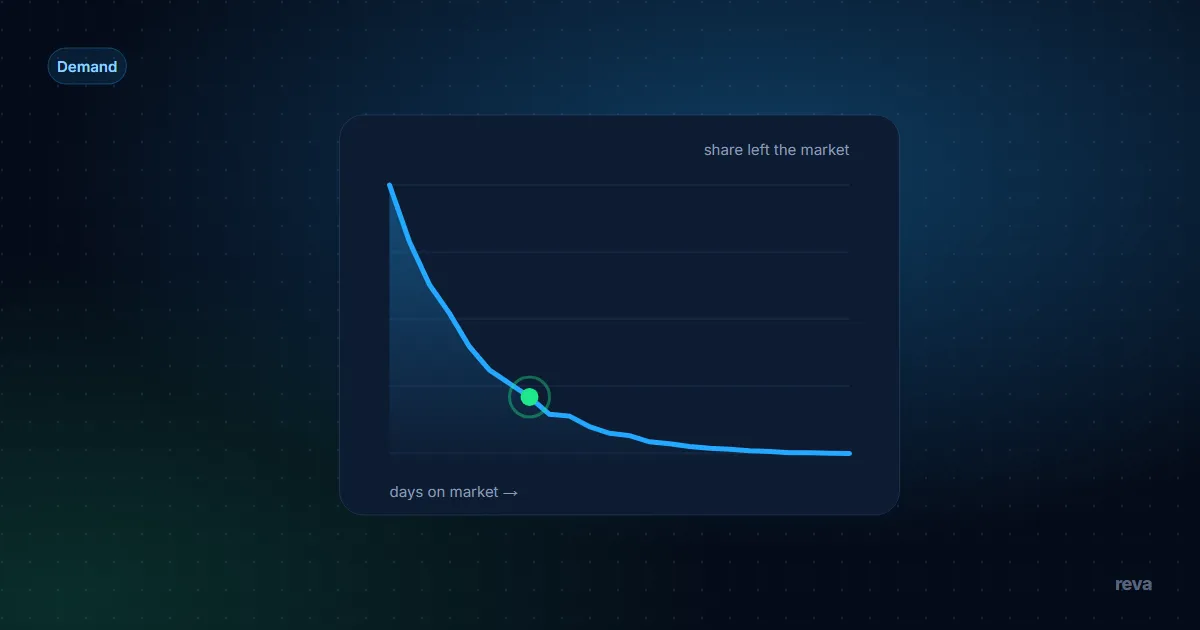
- Demand is the chance that a comparable item leaves the market within a set window at a stated price: 1 − (listings still live on day d ÷ listings followed from day 0).
- In our judgement, exits are the strongest of the three signals; favourite counts partly measure exposure, because Vinted's UK 'Our platform' page ranks on engagement such as favourites.
- A listing that disappeared left the market; it may have sold, been deleted, relisted or, on OLX, expired after its 30-day display period.
- Set your own time-on-market limit from when you need the cash back, minus shipping and payout days, instead of relying on any quoted average.
- Compare margin and liquidity with one number: profit ÷ buy cost × 30 ÷ days to cash.
- Demand vs price: two different questions
- Signal 1: how many similar live listings compete
- Signal 2: favourite speed on new listings
- Signal 3: how quickly similar listings leave the market
- Turning exits into a chance to leave within 7 days
- How to estimate typical days on market for your brand and category
- Liquidity: how fast an item turns into cash
- Liquidity vs margin on a small budget
- Traps: seasonal spikes, relists and price-drop noise
- How to check demand for resale items: a quick routine
To check resale demand before you buy, follow a group of comparable listings from the day they go live and count how many leave the market within a set window, such as 7 days. Two supporting signals sharpen that count: how many near-identical listings compete, and how fast fresh ones collect favourites. The answer is a probability at a price, not a yes or no.
A disappeared listing is not a confirmed sale, so everything here is an estimate. This page shows how to check demand for resale items on Vinted, OLX and Allegro Lokalnie, turn exits into time on market and liquidity, and spot the traps that fake demand. It is the demand chapter of our product sourcing guide.
Demand vs price: two different questions
| Price question | Demand question | |
|---|---|---|
| Asks | What will a comparable item fetch? | Will it leave the market by day X? |
| Evidence | Last visible prices of comparable exits | Share of comparables gone by day X |
Decision rule: a fair value with no exits behind it is a price without demand evidence. Until your cohort check says otherwise, pay only what still breaks even at a quick-sale price.
Signal 1: how many similar live listings compete
Count near-identical live listings: same brand, model, size band and condition. Then set the count against how many leave.
Example: 30 comparable listings are live. Over the last 14 days you logged 21 exits, 1.5 a day. Days of supply: 30 ÷ 1.5 = 20 days.
You also see a ranked slice, not the whole shelf. Vinted's UK "Our platform" page (section 8) says ranking uses upload age, price and brand, engagement, the buyer's own history and Bumps, so scroll past the first screen before you count.
Decision rule: if days of supply is longer than your time-on-market limit, buy only at a price that lets you list near the cheapest quarter of comparable asks. The quick sale price calculator finds that price and checks it against break-even.
Signal 2: favourite speed on new listings
Total favourites on an old listing mostly measure how long and widely it was shown, and because Vinted ranks on engagement, exposure and favourites feed each other. Measure speed instead: favourites in the first 48 hours on comparables you catch on day one.
Example: five fresh listings of one jacket model average 6 favourites in 48 hours; five of a similar model average 1. That ranks interest between the models. It says nothing about purchases.
Counts are also rough. Vinted's terms forbid external software used for "adding Items to favourite" unless Vinted allows it, and a count cannot show you how each favourite was added.
Decision rule: fast favourites with few exits means interest without buying at those prices.
Signal 3: how quickly similar listings leave the market
This is the signal closest to buying behaviour. Work in cohorts:
- Pick comparable listings that went live within the same few days. Record price, date and a screenshot.
- Recheck on fixed days, for example day 1, 3, 7 and 14.
- Confirm each exit on the next pass, since a listing that drops out of view can come back; why a vanished Vinted listing may not have sold lists the reasons.
- Drop relists: the same photos in a new listing are the same item.
| Signal | Tells you | Cannot tell you | Weight (our judgement) |
|---|---|---|---|
| Competition | How long the queue is | Whether buyers exist | Medium: you see a ranked slice |
| Favourite speed | Interest between models | Purchases; exposure inflates it | Low |
| Exits | How fast comparables stop being available | Whether they sold, or for how much | Highest, still an estimate |
Turning exits into a "chance to leave within 7 days"
Survival analysis asks what share of a group is still "alive" after each day. Applied to listings:
Split the cohort by price band, because one model has a different curve at each price.
- Priced near the cheapest quarter (12 listings)
- Priced at market ask or above (13 listings)
Small cohorts swing: with 12 listings, one exit moves the figure by about 8 percentage points. Write the cohort size next to every chance you record.
How to estimate typical days on market for your brand and category
No marketplace page in our research publishes a typical time on market for any brand or category, and neither do we.
Median days on market is the first day on which half the cohort has left. In the example, the cheap band reaches 50% on day 7. The market-ask band is still at 54% on day 14, so record its median as "over 14 days", not a guess, or extend the check.
Keep one row per brand, category, size band and price band, with cohort size, season and date. Your own stock is measured differently: how long your own items take to sell and your sell-through rate come from your sales records.
To set your own limit, work backwards from your cash:
Example: you want cash back within 30 days, and shipping plus payout usually takes you 10. Your limit is 20 days. A model whose cohort at your planned price has a median over 20 days fails at that price.
Liquidity: how fast an item turns into cash
Liquidity is the whole path back to your bank account. The term's measurable proxies — days to sell, exits per week, the spread of asks — are defined in market liquidity.
The last two terms depend on the marketplace. OLX.pl's Terms (effective 27 April 2026, §11.7) say OLX orders the payout when the buyer confirms receipt, or 48 hours after pickup or delivery if no Pakiet Ochronny claim is filed. Bank transfer time is unconfirmed. For Vinted's shipping deadline and payout steps, see how long it takes to sell on Vinted. Use your own logged days, not the fastest case.
Liquidity vs margin on a small budget
A bigger profit that takes longer can earn less over a month, if the cash would have bought something else. Put both on one scale:
Decision rule: if your budget covers only a few items at once, prefer the right-hand column, as long as profit per item clears your floor. The full buy-or-pass routine is in how to evaluate a resale deal in 60 seconds.
Traps: seasonal spikes, relists and price-drop noise
Some exits and "new" listings come from marketplace mechanics, not buyers.
- Scheduled endings. OLX displays a listing for 30 days from publication, with other periods in some subcategories (Terms §8.8); auto-extension, where used, republishes it for another 30. A listing gone around day 30 may simply have expired. Allegro Lokalnie auctions last 7 days, so an auction ending on day 7 is the format, not demand.
- Refreshes. OLX's Odświeżenie moves a listing up as if it were newly added (Annex 2). Keep refreshed listings out of a day-0 cohort.
- Relists. Vinted's terms say users must not "delete and re-list the same Item multiple times or multiple Items in bulk". In OLX's free and limited categories, the Terms count a new listing for an item ended less than 14 days earlier as a duplicate. Match photos before counting. Vinted's updated Terms take effect on 5 October 2026 (Germany, France) and 8 October 2026 (UK, US, Poland); Value Added Resource reports no change to relisting rules in the UK, US and Australia update.
- Price-drop noise. A listing that exits a day after a price cut belongs in the lower price band.
- Seasonal spikes. Winter coats tracked in October tell you little about March. Measure in the season you plan to sell.
How to check demand for resale items: a quick routine
- Define the comparable: brand, model, size band, condition, marketplace
- Count live comparables past the first screen
- Start a cohort of listings from the last day or two; note price band and cohort size
- Note favourites at 48 hours on the fresh ones
- Recheck on day 1, 3, 7 and 14; remove relists, refreshes and expiries
- Calculate the chance to leave within 7 days per price band
- Add shipping and payout days, then return per 30 days
- Buy only if the chance at your planned price meets the one you set
Run it across several brands and you have a niche study; how to find a reselling niche shows how to record it, and our data methodology explains why every figure here says "left the market".
Frequently asked questions
Do favourites mean an item will sell?
How do I measure demand without sold data?
How do I set my own time-on-market limit for a flip?
Should I choose margin or liquidity?
Sources
- Vinted UK: Our platform (section 8, ranking) checked 13 Sept 2026
- Vinted UK Terms and Conditions (version applicable from 30-04-2026, with update notice) checked 13 Sept 2026
- Vinted PL Regulamin (version in force from 15-09-2025, with update notice) checked 13 Sept 2026
- Vinted DE Nutzungsbedingungen (version from 08-09-2025, with update notice) checked 13 Sept 2026
- Vinted FR Conditions générales (version from 08-09-2025, with update notice) checked 13 Sept 2026
- OLX.pl Terms (Regulamin), effective 27 April 2026 checked 13 Sept 2026
- OLX.pl Annex 2: promotion services (V28) checked 13 Sept 2026
- Allegro Lokalnie: Sprzedaj teraz checked 13 Sept 2026
- Value Added Resource: Vinted US, UK and Australia terms update, October 2026 checked 13 Sept 2026
See live opportunities
Scout shows finds priced below the level where similar items leave the market. Every price is an estimate you check before you buy.
reva estimates prices from public listings. Estimates, not guarantees.Keep reading

Where resellers find stock and how to judge it: online listings, second-hand shops, bales, alerts, buying rules, demand checks and fake detection.
25 min read
Can you see sold prices on Vinted? What the app shows, why 'sold filter' tips conflict, and honest ways to estimate what similar items went for.
9 min read
Vinted publishes no average time to sell. How to measure days on market for your own listings, estimate it for similar items and what price and season change.
8 min read