 reva
revaMarket Liquidity
How easily an item becomes cash near its fair price.

- Liquidity is a property of a market at a price level, not of an item: the same brand is liquid at the median ask and illiquid at a top-decile one.
- Three measurable proxies: days-to-sell of comparable exits, exits per week on a saved search, and the spread between median asks and median exits.
- Cash flow runs on liquidity before margin: 35 zł that repeats weekly beats 150 zł that arrives once a quarter.
- Liquid categories reward speed; illiquid ones reward patience, knowledge and a lower max buy price — mixing the strategies up is how stock strands.
- No EU platform publishes liquidity statistics, so a one-week saved-search log is the honest measurement.
Market liquidity, in resale terms, is how quickly and reliably an item becomes cash near its fair price: liquid markets have a stream of buyers; illiquid ones strand fairly priced items for months. Sourcing runs on it — liquidity decides whether your money comes back next week or next season, before margin decides how much comes back. Below: the term in operational use, three proxies computable from any saved search, and how strategy changes on each side.
Definition in resale terms
Both halves carry weight. "Quickly" is measurable — exit times of comparables. "Near its market price" is the part advice skips: an item movable only after a 50% cut was not liquid for you. And liquidity is a property of a market at a price and condition point, not of an item.
Why liquidity matters more than margin for cash flow
Paper profit is not cash until a buyer appears. Example: an armchair flipping for 150 zł profit in three months, against jeans making 35 zł in a week — about 1.7 zł per day against 5. The jeans' capital frees immediately, so the same 300 zł works several pairs at once while the chair eats its 300 zł for a season. That is the argument of reseller cash flow: conversion speed decides whether an operation compounds or clogs; margin only sets the size of each turn.
Three measurable proxies you can compute
- Exit times of comparables. Log when matched listings disappear from a saved search; the median of those times is your speed read. Method and traps: days to sell.
- Exits per week. Example: 14 matched listings on Monday, 3 gone by Friday — a moving market. Fourteen still there a month later is not.
- The ask–exit spread. Median live ask versus median exit. Asks cluster around 120 zł while exits went at 85–95 zł — buyers only move at a visible discount: a thin market wearing a busy one's clothes.
No EU marketplace publishes liquidity statistics; these logs are the honest measurement — one saved search, ten minutes a week.
Liquid vs illiquid categories: examples and the trap
Typical patterns, not data, and they shift by city and season: current-season high-street clothing in common sizes, kids' basics, phones and consoles in honest condition, and flatpack furniture locally tend to sit on the liquid side; niche collectibles, unproven vintage and high-ticket items needing trust sit on the illiquid side.
The trap is treating those lists as answers: liquidity lives at a price × condition point. A fast-moving brand at a top-decile ask is illiquid for you — the buyers are all buying the cheaper listings. Measure the exact search you will sell into; how to check resale demand is the practical version.
How strategy changes with liquidity
In liquid markets, speed is the edge: price near the fast-sell level, reply same day, relist immediately after a no-show. In illiquid ones, discipline is the edge: a bigger discount at purchase, scheduled price revisions, storage that is genuinely free. Problems start when the strategies swap: volume speed sells a 150 zł margin item to the first lowball. Where to find items worth testing is in the best things to resell; the buying framework around them is the product sourcing guide.
Related terms
Sell-through rate measures the share of stock that moved in a period; exit-time medians measure pace per item; the ask–exit spread measures price integrity. Together they form the demand picture to check before any purchase.
Related guides
Frequently asked questions
What does liquidity mean in reselling?
Which second-hand categories are most liquid?
How do I measure liquidity on a marketplace?
Is it better to sell liquid or illiquid items?
See live opportunities
Scout shows finds priced below the level where similar items leave the market. Every price is an estimate you check before you buy.
reva estimates prices from public listings. Estimates, not guarantees.Keep reading

Where resellers find stock and how to judge it: online listings, second-hand shops, bales, alerts, buying rules, demand checks and fake detection.
25 min read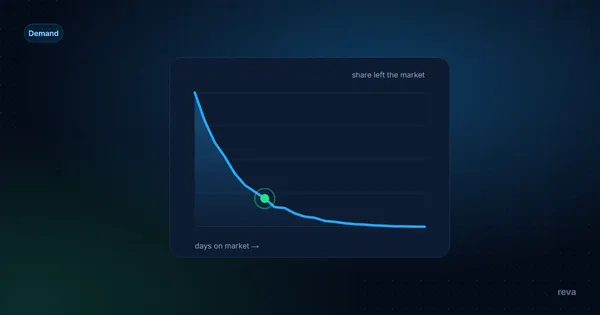
Check resale demand before you buy: live competition, favourite speed, how fast similar listings leave the market and liquidity vs margin, no sold filter.
9 min read
Sell-through rate is the share of listed items that sell in a period: the formula, a free calculator, a reseller example and how it differs from turnover.
6 min read