 reva
revaHow to Price an Item With No Comparables
When the market is silent, you price like a scientist: anchor, test, revise.
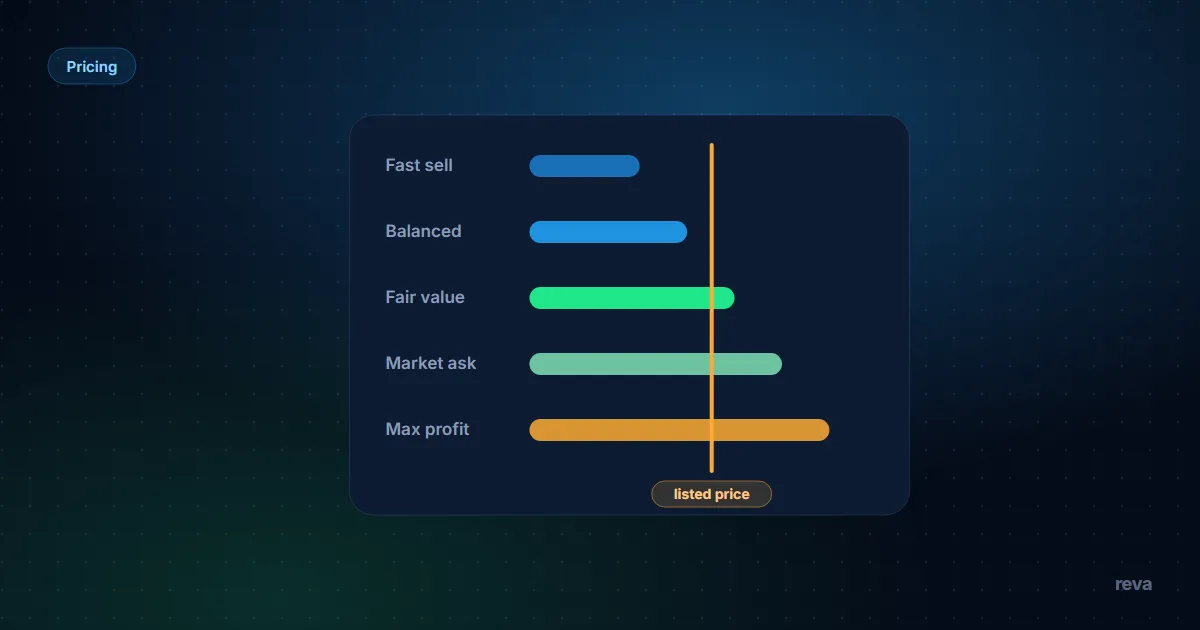
- No comps does not mean no price: anchor on the nearest comparable category, compute a cost-plus floor, then run price discovery with revision dates set before you list.
- Cost-plus is a floor, not an estimate — it tells you the lowest acceptable price, never what the market will pay.
- Judge a rare-item listing by its response log (views, favourites, offers) against the dates you set, not by how the number feels.
- Never anchor on the highest ask you can find: one stale listing is an unproven claim, not evidence.
- An auction is honest price discovery only where an audience actually exists — two watchers just produce a low number with a deadline.
- Why check sold comps fails for rare items
- The four methods, in order of reliability
- Method 1: the nearest-category anchor
- Method 2: cost-plus as a floor, not an answer
- Method 3: deliberate price discovery with a revision plan
- Method 4: let the market bid — auctions and offers
- Setting revision dates before you list
- What never to do: pick the highest ask you can find
- Related guides
Knowing how to price items with no comps comes down to a discipline in three moves: anchor on the nearest comparable category, compute a cost-plus floor, then run deliberate price discovery — list at the anchored ask, measure the response, revise on dates you set before listing. No marketplace publishes price data for one-off items, and no public averages exist for EU resale, so there is nothing to look up. Below: four methods in order of reliability, the revision plan that replaces missing data, and the one anchor you should never use.
Every price on this page is a worked example, not market data.
Why "check sold comps" fails for rare items
The comps method needs a stream of comparable items leaving the market at observable prices. A one-off — a hand-painted vase from a studio that closed decades ago, a discontinued tool, a jacket in an unusual size — returns two listings in the whole country, in different condition, at asks nobody has paid. That is not a market; it is a coincidence.
Decision rule: if fewer than three matched comparables are live or recently gone on your platform, treat the comps method as unavailable and switch to the methods below. Two loose asks cannot give you a median, and a median of asks is not a price anyone paid anyway — finding sold comparables covers the matching discipline; this page starts where it stops.
The four methods, in order of reliability
- 1Count matched comparablesThree or more close matches on your platform? Use the normal comps method and stop here.
- 2Find the nearest live categorySame material, function and size class — not the same vibe. Note its median ask.
- 3Adjust the anchorMove the number for what differs: maker, era, completeness, flaw. One sentence per adjustment.
- 4Compute the cost-plus floorItem cost, direct costs, fees, your minimum pay for the work. The floor is the line you never cross.
- 5List at the anchor, set revision datesDay 10, day 20, day 30 — with a written rule for what the evidence at each date means.
- 6Revise on the datesOne step down per date, or hold with a reason written down. The floor is the stop.
Reliability falls as you go: an anchor from a live category is evidence, a floor is arithmetic, price discovery is an experiment, and an auction result is only as good as its audience. Use them in that order.
Method 1: the nearest-category anchor
Find the closest category that does have a moving market — same material, function and size class. Say your item is a hand-painted ceramic vase, 28 cm, signed by a studio artist. Nothing comparable is listed anywhere. The nearest live category: decorative ceramic vases, 20–35 cm, good condition. Twelve live asks between 40 and 160 zł, median 85 zł. That is the anchor.
Then adjust for what actually differs, and only for what you can defend in one sentence to a buyer. A documented studio mark is rarer than plain decor, so say you set the ask at 110 zł — a step above the median, below the top asks. An unverifiable signature is worth what a buyer can verify, which is often nothing. If you cannot name what differs, do not adjust.
Rules for the anchor: take the median of the nearest category, never its cheapest or priciest listing; adjust in one direction at a time; write the reason next to the number.
Method 2: cost-plus as a floor, not an answer
Example: you bought the vase at an estate sale for 25 zł, cleaning and packing materials add 10 zł, you estimate the marketplace's cut at 8 zł, and you decide your time on cleaning, photos and the listing is worth at least 40 zł. The floor is 25 + 10 + 8 + 40 = 83 zł.
The floor answers a different question than the anchor. It tells you when to walk away — from a sale, or from the whole flip — and it is the number price discovery stops at. It never tells you what the market will pay: a price the market rejects is not made right by your costs. If an honest discovery run cannot clear the floor, the options are hold, improve the listing, or keep the item.
Method 3: deliberate price discovery with a revision plan
This replaces missing data with an experiment you control. List at the anchored ask, log views, favourites and offers, and revise at dates fixed in advance.
Example, the vase: listed at 110 zł with the plan written on day 0.
| Date | Evidence you check | Rule |
|---|---|---|
| Day 10 | views, favourites, offers | Favourites but no offers: hold one more cycle. Silence — near-zero views and favourites: fix photos and title first, the price was never seen. |
| Day 20 | same, compared with day 10 | Step down one level: 110 → 100 → 90. |
| Day 30 | any offer above the floor of 83 zł? | Accept, counter above the floor, or pull the item. |
The discipline is the plan, not the specific days. You never revise mid-cycle because of one rude message, and you never skip a date because the listing "feels" close to selling. What the response log means at each stage — views without favourites, favourites without offers — is the same evidence used in the overpriced check, just run in reverse: you are listening for the market's first reaction to a number nobody has tried before.
Method 4: let the market bid — auctions and offers
Where a platform format aggregates bidders, an auction is price discovery you do not have to run: the crowd sets the number. It only works with an audience. Before choosing the format, look for evidence of one — comparable listings with watchers, a category where items actually leave the market during auction-length windows. Two watchers produce a low number with a deadline, which is worse than no information because it feels official. The format mechanics and the costs of auctions versus fixed price are compared in eBay auction vs Buy It Now.
On chat-based marketplaces, inviting offers works the same way, slowly. Either way, method 4 stands on method 2: without a floor computed in advance, the first low bid becomes your price.
Setting revision dates before you list
Whatever intervals you pick, attach a rule to each date and write them down before the listing goes live. Dates tied to listing age work best because marketplaces reward fresher listings with visibility, so each revision also buys a small second debut. The step-down schedule, and the rules platforms set on deleting and re-listing the same item, are in when to lower a price.
If the whole category is quiet — no exits, few new listings — price is not your problem yet. Checking demand before you buy covers the checks that still work when a market is too thin to prove anything from prices.
What never to do: pick the highest ask you can find
The one listing asking 480 zł for "similar" has been up since March with no activity. It is not the market's verdict; it is one seller's unwithdrawn claim. Anchoring there produces a stale listing of your own, and listing age itself then costs visibility — a compounding penalty covered in the overpriced check above.
The full pricing method these four slots into — levels, confidence, revision logic — is the resale pricing guide.
Related guides
Frequently asked questions
How do I price something nobody else is selling?
Is it better to start high or low with a rare item?
How long should I wait before changing the price?
Can I ask buyers to make offers instead of setting a price?
Analyze an item with reva
Open any find and see its five-level price ladder, demand score and price confidence, built from comparable items that left the market. Estimates, not guarantees.
reva estimates prices from public listings. Estimates, not guarantees.Keep reading

How to price used items for resale: comps from sold and live listings, condition, price levels from fast sale to max profit, markdowns, offers and bundles.
21 min read
What sold comps are and how to find them on Vinted, OLX and Allegro Lokalnie with no sold filter: match brand, size and condition, and how many you need.
9 min read
Five price levels, from fast sell to max profit, what each is based on and when to choose it depending on cash needs, demand and how long you can wait.
8 min read