 reva
revaFast Sale or Max Profit? How to Choose a Price Level
One item, five defensible prices. The right one depends on your goal.
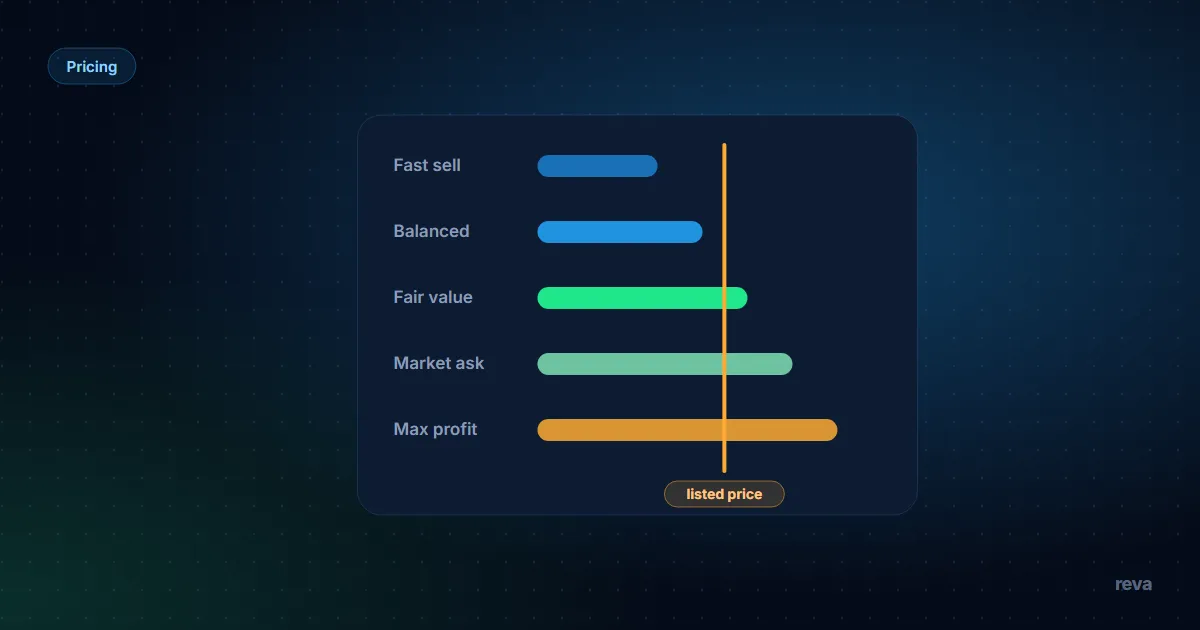
- Each ladder level rests on named evidence: fast sell on the cheapest quarter of live asks, fair value on the median of comparable items that left the market, market ask on the median live ask, max profit on a cap of fair value × 1.25.
- Use the median, not the average: in this page's Levi's example one 260 zł exit lifts the average of 11 exits to about 129 zł while the median stays at 120 zł.
- Stretch towards max profit only when close comparables leave the market steadily and you can wait. With a high cash need, start at fast sell or balanced.
- A fast sale can out-earn a patient one when the cash goes straight into another item: in the example, two quick flips at 39 zł each beat one sale at fair value (60 zł).
- Vinted lists price among its ranking attributes but publishes no weight or direction, so pick a level for demand and cash, not for ranking.
- Why one item has several reasonable prices
- Fast sell and balanced: how to price to sell fast
- Fair value: the median of items that left the market
- Why the median, not the average
- Adjusting fair value for time and condition
- Market ask and max profit: the top of the ladder
- Fast sale price vs max profit: how demand changes the right level
- Examples: a cash-tight seller and a patient seller
Choosing a fast sale price vs max profit comes down to two questions: how soon you need the cash, and how often comparable items leave the market. Need the money this week? Start at fast sell, near the cheapest quarter of comparable asks. Can you wait while close comparables leave steadily? Stretch towards max profit, capped at fair value × 1.25.
This page builds all five levels, each from its own evidence, for one used pair of Levi's 501 jeans. The full method is in the resale pricing guide. Vinted facts were checked on 13 September 2026; every other number is an example.
Why one item has several reasonable prices
Two sellers can price the same jeans 50 zł apart and both be right: one needs the money this week, the other can wait a month.
You have two kinds of evidence: listings still live (asks) and listings that disappeared (exits). An exit "left the market" rather than "sold", because the seller may have deleted it or sold elsewhere; the data methodology page explains why. How to find sold comps shows how to collect both.
Fast sell and balanced: how to price to sell fast
Fast sell sits near the cheapest quarter of comparable live asks. By hand, sort the asks from cheapest and take the one at the lower-quarter position: with 12 asks, position 3, so 99 zł. Not the cheapest pair at 89 zł, which may hide a flaw. The quick sale price calculator takes that ask and your fair value and shows the profit at each.
Balanced has no evidence of its own; it hedges between two levels that do: (99 + 120) ÷ 2 = 109.50 zł. Use it when your comps are thin or loose.
Decision rule: if profit at fast sell is negative, it is not a fast sale but a loss. Vinted's UK and Poland price lists show no seller commission line (checked 13 September 2026). Example, with the buyer paying shipping: 99 zł on your 60 zł pair returns 39 zł. Vinted's updated Terms take effect on 5 October 2026 in Germany and France and on 8 October 2026 in the UK and Poland, so check the price list again after those dates.
Fair value: the median of items that left the market
Fair value is what resellers mean by fair market value (FMV): the median last price of comparable items that left the market. Take the middle of the 11 sorted exits, the 6th: 120 zł. It is a resale estimate, not a valuation for tax or accounting; for those, ask a tax adviser. The glossary unpacks the term — fair market value in resale — including why its evidence is exits, never asks.
Why the median, not the average
The average of the 11 exits is 1,420 ÷ 11 ≈ 129 zł, lifted by one 260 zł pair. Drop that pair and the average falls 13 zł to 116 zł, while the median moves only 2.50 zł to 117.50 zł.
Decision rule: if one exit sits far from the rest, open that listing before you keep it. It may be a different item.
Adjusting fair value for time and condition
Split your exits by date. Example: the five exits from the last two weeks (95, 110, 120, 130, 140 zł) and the six older ones both have a median of 120 zł, so nothing needs correcting. Had the recent median been 105 zł, you would price from the recent exits with lower confidence, because five pairs is thin evidence. With asks logged in both periods, the sold comps guide scales older exits by the ask-median ratio.
Comps price a condition grade, not your pair. If yours has a flaw most comps don't show, such as a frayed hem, start one level lower and photograph it. Vinted's help page on significantly not as described items lists undisclosed damage as grounds for a claim. How condition changes resale price covers grading.
Market ask and max profit: the top of the ladder
Market ask is the median of comparable live asks: (135 + 139) ÷ 2 = 137 zł. It shows what you compete against, not what buyers pay, and it tends to sit high, since the best-value listings are likely to leave first.
- Left the market (per 20 zł band)
- Live asks (per 20 zł band)
- Fair value: 120 zł
- Market ask: 137 zł
- If the median ask is close to fair value, market ask is a realistic place to start.
- If it is above fair value × 1.25, many asks are listings buyers passed over. Price from the exits.
Max profit is never above fair value × 1.25: here 120 × 1.25 = 150 zł. The cap belongs to this method, not to any marketplace rule, and keeps you out of the long tail: four of the 12 asks (155 to 239 zł) sit above it. Start there only if every box is ticked:
- A handful of exact comps: same model, size and condition
- Exits spread across recent weeks, not one old burst
- Nothing in your pair that the comps lack, such as a flaw
- A written date to step down one level if no offers arrive
Otherwise start at market ask or fair value. When a listing stalls, when to lower your price steps it down one level at a time.
Fast sale price vs max profit: how demand changes the right level
Demand decides whether waiting pays: when comparables rarely leave the market, a max-profit price just sits. Count the close comparables that left over a period you choose, and weigh that against how soon you need the money. How to check resale demand turns those exits into a chance of selling within a time window.
Vinted's Our platform page lists price among its ranking attributes, and its pricing help page says a price below the catalogue average may help an item sell faster. Neither says how much price weighs, so choose for demand and cash.
Examples: a cash-tight seller and a patient seller
Two sellers own the 60 zł pair, sell on Vinted with no seller commission, and the buyer pays shipping.
| Cash-tight seller | Patient seller | |
|---|---|---|
| Starts at | Fast sell, 99 zł | Max profit, 150 zł |
| Profit at the first price | 39 zł | 90 zł |
| Plan with no offers | Hold; check cost before going lower | Market ask (137 zł), then fair value (120 zł) |
| Profit at the last step | 39 zł | 60 zł |
Example: the cash-tight seller puts the 99 zł into a second 60 zł pair that also goes at fast sell before the patient seller's pair moves. Two flips return 78 zł. Market ask (77 zł profit) roughly ties that, fair value (60 zł) loses, and only max profit (90 zł) clearly wins.
Decision rule: if you can reinvest the money faster than a higher level would sell, price lower. If you can't, the extra margin is real, so price higher and plan the steps down.
Frequently asked questions
What is the difference between fair value and asking price?
Is fair value the same as the average sold price?
When should I price for a fast sale?
How high can I price above fair value?
Does a higher price hurt ranking?
Sources
- Vinted UK: Our platform (ranking factors, §8) checked 13 Sept 2026
- Vinted Help (vinted.com): Choosing the price for your item checked 13 Sept 2026
- Vinted UK Help: Significantly not as described items checked 13 Sept 2026
- Vinted Poland price list (cennik) checked 13 Sept 2026
- Vinted UK price list checked 13 Sept 2026
- Vinted UK Terms and Conditions (version in force, with update notice) checked 13 Sept 2026
- Vinted Poland Terms (version in force, with update notice) checked 13 Sept 2026
- Vinted Germany Terms (version in force, with update notice) checked 13 Sept 2026
- Vinted France Terms (version in force, with update notice) checked 13 Sept 2026
Analyze an item with reva
Open any find and see its five-level price ladder, demand score and price confidence, built from comparable items that left the market. Estimates, not guarantees.
reva estimates prices from public listings. Estimates, not guarantees.Keep reading

How to price used items for resale: comps from sold and live listings, condition, price levels from fast sale to max profit, markdowns, offers and bundles.
21 min read
Estimate a quick-sale price for a second-hand item from the asking prices you see, then check it against your break-even so a fast sale isn't a loss.
6 min read
A markdown schedule for listings that aren't selling: when to cut, by how much, when to stop, and how to tell a price problem from a visibility problem.
8 min read