 reva
revaHow Condition Changes Resale Price
Grade honestly, price accordingly, and avoid not-as-described claims.
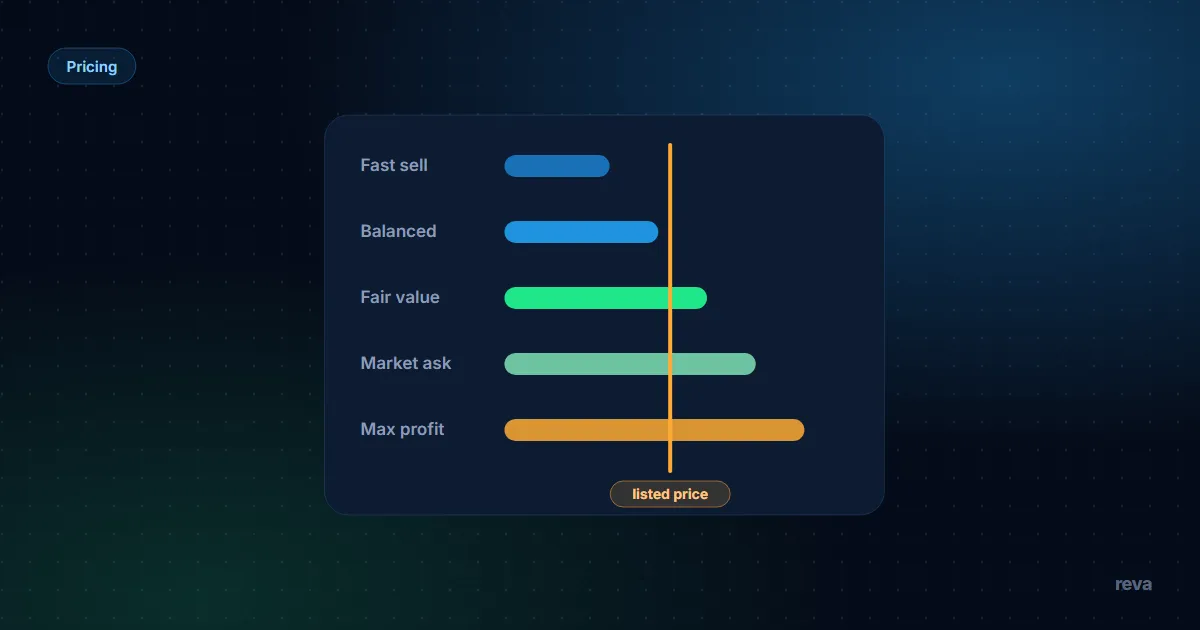
- Vinted's help page 376 (checked 13 Sept 2026) suggests 60–80% of retail for New / Like new, 40–60% for Very good and 20–40% for Good / Satisfactory. The bands share their edges, so near 60% or 40% the grade costs you nothing in price.
- Decide first whether a flaw moves the item down a grade or only down a price level inside its grade, then photograph it. Pricing and disclosure are one decision.
- Undisclosed damage or missing parts, wrong size or colour, different main materials and functions not as described count as significantly not as described on Vinted UK; OLX's Pakiet Ochronny also covers a 'new' item showing wear.
- Grading up to reach a higher band buys claim risk, not margin: a refunded Vinted UK claim returns the item price, Buyer Protection fee and original shipping to the buyer, and on OLX you also pay the return postage.
Resale price by condition starts with Vinted's own guide: 60–80% of the retail price for New / Like new, 40–60% for Very good and 20–40% for Good / Satisfactory. Those bands set the outer limits. Comparable listings in the same grade set the actual price, and every flaw you disclose, or fail to disclose, decides whether the sale sticks.
Below: where the percentages mislead, which flaws cost a grade, and how a wrong grade becomes a claim. The wider method is in the resale pricing guide. Facts checked 13 September 2026; example prices are invented.
Condition grades used by marketplaces
Vinted's Catalogue Rules make condition a required field and say defects must be described in the item description. Its pricing help page (376, same bands on the UK, .com and .pl sites) sets three price bands: New / Like new, Very good and Good / Satisfactory. Unworn and lightly used items share the top band.
OLX.pl's documents we read name no grades, but its buyer protection makes the word "new" a claim: Annex 8 (Pakiet Ochronny, version of 27 April 2026) covers an item that doesn't match the listing, including undisclosed damage, an incomplete item and a "new" item showing wear.
Decision rule: grade by what the buyer will see, not by how little you wore it. Visible wear, fading or a mark takes an item out of New / Like new, whatever the tag says.
- Small moth hole on the back hem, not shown or mentioned
- Undisclosed damage: a claim reason on Vinted UK and OLX
- Inside the Good band for a coat that cost 400 zł new (80–160 zł)
- The buyer accepts the flaw before paying
Resale price by condition: Vinted's official guidance
The bands are a share of retail price:
Example: a wool coat cost 400 zł new. New / Like new gives 240–320 zł, Very good 160–240 zł and Good 80–160 zł.
The UK page adds two levers: "setting a price that's lower than our catalogue average price might help you sell faster", and "a discount may help you sell the items that do not fit the current season". The page gives no figure for that average; your comparables stand in for it.
Why official ranges are only a starting point
In the coat example, Very good alone spans 80 zł. Three things decide where you land:
- Retail price you can prove. Without a receipt or the brand's own price, the formula has no input. For older pieces, pricing vintage clothing works from label era, material and measurements instead.
- Comparables in the same grade. Match your condition, then open the photos to check the grade is real. The median of comparables that left the market places you inside the band; finding comps on Vinted, OLX and Allegro Lokalnie has the routine, and how to price items on Vinted adds the buyer fee. Why "left the market", not "sold": see the data methodology page.
- Where the band edges meet. Good at 40% and Very good at 40% are the same price. If your honest price lands on an edge, take the lower grade: same money, lower buyer expectations.
Decision rule: if same-grade comparables sit outside Vinted's band, check their grade, model and season before you trust either number. If they genuinely match, follow the comparables.
Flaws that cut price most
No marketplace page we read publishes what each flaw costs, so distrust fixed "minus X% for a stain" rules. The rules do show which hidden flaws become claims: Vinted's UK help page 1090 lists undisclosed damage, undisclosed missing parts, incorrect size, wrong colour, different main materials, counterfeit and functionality not as described.
Our method, not a platform definition:
| Flaw | Grade effect | Pricing action |
|---|---|---|
| Visible from arm's length: stain on the front, hole, heavy fading | Down one grade band | Price inside the lower band; flaw in the title and a photo |
| Only close up: light pilling at cuffs, a faint mark inside | Keep the grade | One price level lower than clean comps; close-up photo |
| Missing part: belt, box, charger, dust bag | Keep the grade, change the comps | Compare with listings missing the same part; say so |
| Doesn't work as it should: zip, button, battery, screen | Good / Satisfactory at best | Say exactly what fails; hidden faults are a claim reason |
| Label size and real size differ (shrunk, altered) | Keep the grade | Give measurements; incorrect size is a claim reason |
Photos: showing condition to justify price
Photos are your evidence that price and grade match. Vinted's Catalogue Rules say photos must be real, not stock photos or photos from ads, so what the buyer sees in your pictures is what they should find in the parcel.
- Whole item in daylight, front and back
- Brand label and size label, readable
- Every disclosed flaw close up, with a coin or ruler for scale
- Measurements for clothing, laid flat
- All included parts in one shot, so a gap is obvious
Pricing near the top of a band? Add clean close-ups of the parts that wear first: cuffs, collar, soles, screen. Lighting, backgrounds and moderation risk are in product photos that sell second-hand items.
Condition and not-as-described claims
The grade you choose is the claim a buyer can test. The Vinted rules below come from UK help pages; check your country's site. A Vinted UK buyer has 2 days from Vinted's notice that the parcel should have arrived to report an item as significantly not as described (help 1356). Minor differences such as lighting don't count, and neither does disclosed wear on electronics (help 1090).
If a claim ends in a return, Vinted's UK help page 272 says the buyer pays return shipping, and the refund covers the item price, the Buyer Protection fee and the original shipping. On OLX, an accepted Pakiet Ochronny claim means the buyer returns via Zwroty OLX at the seller's cost and is refunded the price, delivery and the Pakiet Ochronny fee (Annex 8).
Example: the coat listed as Very good at 220 zł with the hole hidden earns 70 zł more than Good at 150 zł only if nobody looks at the hem. If the buyer claims and wins, you get the coat back, no payout, and relist it as Good anyway. On OLX the mistake also costs you return postage.
Vinted has announced updated Terms taking effect on 5 October 2026 (Germany, France) and 8 October 2026 (UK, Poland). Press coverage (Value Added Resource, September 2026) reports that refund rights move to a separate Refund Policy and the Buyer Protection fee becomes "Vinted fee". Re-read your country's refund wording after those dates. Windows and private vs Pro differences are in Vinted returns and not-as-described claims.
Worked examples
Example 1, Vinted, clothing. A jacket cost €120 new; light pilling at the cuffs shows only close up. Very good gives €48–72. Five same-grade comparables left the market at €50–70, median €58. Keep Very good, list at €55 and add a close-up of the pilling.
Example 2, OLX, trainers without the box. Comparable pairs with the box left the market around 260 zł, without it around 230 zł. The grade stays; the comps change. Price at 230 zł with "bez pudełka" in the title.
Example 3, Vinted, scratched headphones. Retail 600 zł, headband scratches visible from arm's length, everything works. By the table that is Good: 120–240 zł. Photograph every scratch; if Good comps sit high, around 230 zł is defensible. On Vinted UK, disclosed wear on electronics is not a claim reason (help 1090), but an unmentioned fault still counts as functionality not as described.
Frequently asked questions
What percentage of retail should used clothes sell for?
Is 'very good' or 'good' better for pricing?
Should I list flaws in the title?
Does disclosed wear protect me from returns?
Sources
- Vinted UK Help: Choosing the price for your item (376) checked 13 Sept 2026
- Vinted Help (vinted.com): Choosing the price for your item (376) checked 13 Sept 2026
- Vinted Poland Help: price guidance by condition (376) checked 13 Sept 2026
- Vinted UK Help: Significantly not as described items (1090) checked 13 Sept 2026
- Vinted UK Help: Item is significantly not as described (1356) checked 13 Sept 2026
- Vinted UK Help: Returning an item (272) checked 13 Sept 2026
- Vinted UK Catalogue Rules checked 13 Sept 2026
- Vinted UK Terms and Conditions (version applicable from 30-04-2026, with update notice) checked 13 Sept 2026
- Vinted Poland Terms (version in force from 15-09-2025, with update notice) checked 13 Sept 2026
- Vinted Germany Terms (update notice) checked 13 Sept 2026
- Vinted France Terms (update notice) checked 13 Sept 2026
- Value Added Resource: Vinted Europe terms update, October 2026 checked 13 Sept 2026
- Value Added Resource: Vinted US, UK and Australia terms update, October 2026 checked 13 Sept 2026
- OLX.pl Annex 8: Pakiet Ochronny (V20, 27 April 2026) checked 13 Sept 2026
- OLX.pl Help: Co to jest Pakiet Ochronny checked 13 Sept 2026
Analyze an item with reva
Open any find and see its five-level price ladder, demand score and price confidence, built from comparable items that left the market. Estimates, not guarantees.
reva estimates prices from public listings. Estimates, not guarantees.Keep reading

How to price used items for resale: comps from sold and live listings, condition, price levels from fast sale to max profit, markdowns, offers and bundles.
21 min read
Price on Vinted with evidence: condition guidance from Vinted, live competition, listings that left the market, the buyer fee's effect and when to cut.
8 min read
How Vinted not-as-described claims work for sellers: the 2-day window, what counts, who pays return postage, inspection deadlines and how to respond.
8 min read