 reva
revaHow to Estimate Risk in Reselling
The four ways a resale buy goes wrong, and how to price each before paying.
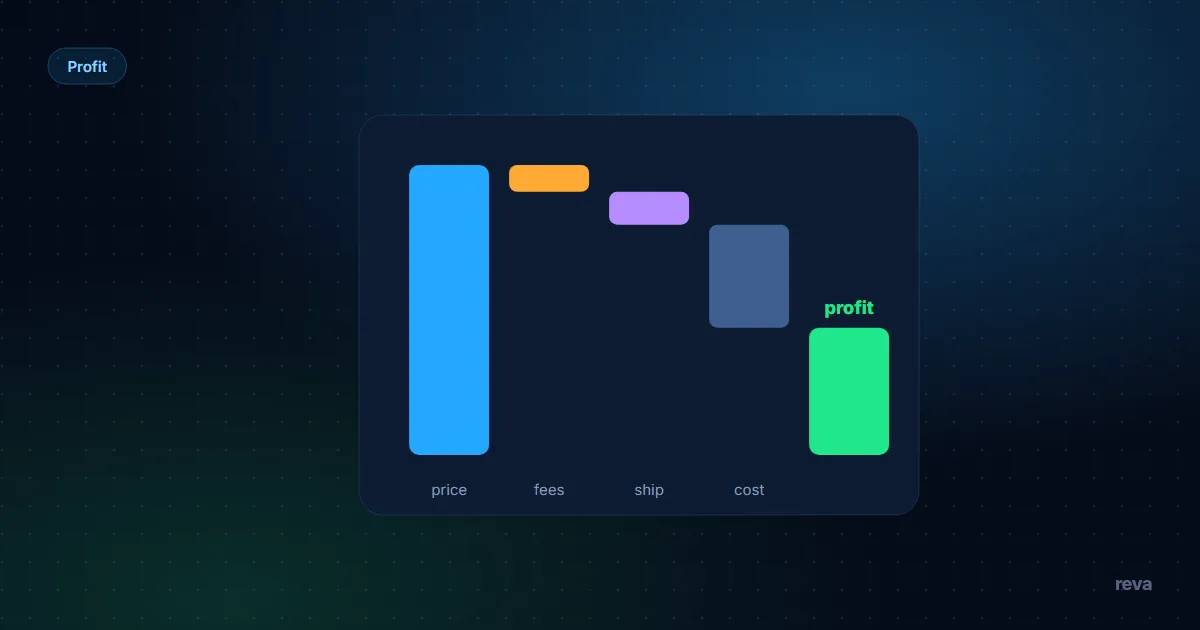
- Risk = downside × chance of the downside. Both parts are estimable before you pay, from comparables and your own records.
- Price every buy at its fast-sell level first: in the worked example a 90 zł target that drops to 65 zł still leaves 19 zł, because the buy price was set from the downside.
- Cash days at risk is its own downside: money locked twice your category median means missed turns, so demand a bigger margin or walk.
- Platform trouble has a price too: orders cancel and buyers get refunds when shipping deadlines are missed, and payouts wait until the order completes.
- Turn the maximum buy price into a written rule, so the ceiling holds on the day the item looks like a bargain.
- Risk = downside × chance; in resale both are estimable
- Downside 1: it does not sell at your target price
- Downside 2: it sells too slowly (cash days at risk)
- Downside 3: condition or authenticity surprise
- Downside 4: platform rules, returns and payment trouble
- A pre-buy risk checklist you can run in two minutes
- Related guides
Risk in reselling is not a feeling; it is a number you can write down before paying: how much you lose if the item does not sell as planned, times the chance of that happening. Split the downside into four checkable parts — no sale, a slow sale, a condition or authenticity surprise, and platform trouble — and each part gets a price in złoty or days. This page is how to calculate risk in reselling with round, worked examples, so the decision happens before the money moves.
Risk = downside × chance; in resale both are estimable
The formula is only useful because both parts come from data you can get. The downside is arithmetic once you know the price where similar items leave the market fastest. The chance is your own history: of the last ten similar buys, how many needed a markdown, how many never sold, how many arrived worse than the photos. Where your history is thin, round the chance up, not down — the cost of caution is a skipped buy; the cost of optimism is stock.
Downside 1: it does not sell at your target price
The target price is a plan, not an outcome. The realistic bad case is selling at the fast-sell level — near the cheapest quarter of comparable asks — because that is what actually clears a stale listing. Price that case first:
- It sells at the fast-sell level instead of the 90 zł target-25 zł
- You paid-40 zł
- Fees and packing-6 zł
- Profit left in the bad case19 zł
Two tools keep this honest. The break-even calculator gives the price where you exactly get your money back — a floor, never a target. And the maximum buy price flips the calculation the right way round: start from the downside payout, subtract costs and your profit floor, and the remainder is the most you may pay:
If the bad case still clears your floor at that price, the buy is safe to make. If it only works at the target price, you are not buying stock; you are buying hope.
Downside 2: it sells too slowly (cash days at risk)
A second downside hides in the calendar: even a full-price sale after 90 days is a worse outcome than a markdown after 20, if the cash had somewhere better to go. Cash days at risk = buy price × days until the payout. Say 80 zł sits for 60 days in a category whose median is 20 days — that is three turns of a fast category missed while one slow piece decides.
Decision rule: if the expected cycle is roughly twice your category median, demand a bigger margin than your floor or walk away. The chance side — how fast comparables actually leave the market — is what checking resale demand measures before you buy.
Downside 3: condition or authenticity surprise
This downside is lumpy: nothing happens, or the item returns a fraction of what you paid. Pre-buy, put a price on each surprise:
- Cleaning and repair: if the photos hide wear, assume you pay for it. Add a number — 10 zł, 20 zł — to the cost side before comparing prices.
- Fakes: if you cannot verify authenticity, price it as a total loss in the maths. A counterfeit that gets flagged usually returns nothing, and the flag can come weeks after the sale.
- Wrong expectation: undisclosed damage found later turns a profit into a refund plus a dead listing.
The rule that follows: never buy an item whose single worst realistic case is bigger than your best realistic profit, unless you can actually verify the thing that would cause it. A 100 zł worst case against a 30 zł best case needs certainty you usually do not have.
Downside 4: platform rules, returns and payment trouble
Platform trouble is the downside people forget to price, and it has two parts. First, the money waits: on Vinted's UK help pages, checked 13 September 2026, payment shows as a pending balance until the order completes — the buyer has 2 days after delivery to confirm or report a problem — and on OLX the payout is ordered when the buyer confirms, or 48 hours after pickup or delivery if no claim was filed. Add those days to every cycle in the sections above.
Second, the sale can reverse. Vinted's UK, Polish, French and German help pages cancel the order automatically if it is not shipped within 5 business days. OLX's Terms, in force since 27 April 2026, refund the buyer automatically if you do not confirm the sale within 72 hours of the order, or do not hand the parcel to the carrier within 3 working days of accepting. Either way the cash goes back to the buyer and the item is back on the rail — a full cycle restart with the clock at zero.
A pre-buy risk checklist you can run in two minutes
Run it before every non-trivial buy; each line takes about twenty seconds:
| # | Question | If the answer is bad |
|---|---|---|
| 1 | At what price do comparable items leave the market fastest? | Unknown? Do not buy until you have checked. |
| 2 | Does the deal still clear your profit floor at that price? | Only works at the target price? Pay less or skip. |
| 3 | What is the most you can pay so the downside still clears the floor? | Turn the number into a buying rule, not a memory. |
| 4 | Can you verify authenticity and full condition before paying? | No? Price a total loss into the maths — or walk. |
| 5 | How many days until the payout, at your category median? | About twice the median or more? Demand a bigger margin. |
| 6 | What is the exit if it does not sell in two review periods? | No exit plan, no buy — that is part of evaluating a deal before it exists. |
The discipline is in the order: price the downside first, the chance second, and only then look at the profit. Done that way round, resale profit stops being a surprise at the end of the month and becomes a decision at the till.
Related guides
Frequently asked questions
What is the biggest risk in reselling?
How do I decide the maximum I should pay for stock?
How much profit justifies a risky buy?
How do I limit losses on stock that did not sell?
Sources
- Vinted UK Help: Vinted Balance, how it works (article 437) checked 13 Sept 2026
- Vinted UK Help: How shipping works (article 753) checked 13 Sept 2026
- Vinted PL Help: shipping (article 753) checked 13 Sept 2026
- OLX.pl Terms (Regulamin), effective 27 April 2026 checked 13 Sept 2026
See price estimates on live finds
This calculator needs your inputs. Scout estimates fair value, a fast-sell price and demand for the finds it shows you. Estimates, not guarantees.
reva estimates prices from public listings. Estimates, not guarantees.Keep reading
Work out what a flip really earns: cost of goods, marketplace and buyer fees, shipping, returns, promotions, ROI vs margin and tracking profit per item.
25 min read
Find the lowest sale price that covers what you paid, marketplace fees and shipping. Free break-even calculator for resellers deciding how far to mark down.
7 min read
Check resale demand before you buy: live competition, favourite speed, how fast similar listings leave the market and liquidity vs margin, no sold filter.
9 min read