 reva
revaAverage Selling Price (ASP)
A useful number that lies to you exactly once per bundle.

- Average selling price = total sales value ÷ number of sales, computed over one category, one condition band and one period you name.
- Example: seven jacket sales of 60, 65, 70, 75, 80, 90 and 400 zł give an ASP of 120 zł and a median of 75 zł — the single 400 zł coat adds about 47 zł to the average.
- A bundle sold as one lot is one sale at the lot price, so lot-heavy months push your ASP down without any real price change.
- When the median sits well below the average, quote the median: it describes the sale a typical buyer actually makes.
- An ASP says nothing about speed or profit on its own — pair it with sell-through and margin before you rebuy a category.
The average selling price (ASP) is total sales value divided by number of sales: seven jackets that brought 840 zł together have an ASP of 120 zł. It is a useful benchmark and an easy number to misread, because one unusual sale moves it a long way without telling you anything about a typical buyer.
Below: the formula, what a marketplace-wide ASP hides, and the median check that catches it.
The formula
Three rules keep the number honest:
- Count money actually received for items that sold, not asking prices.
- Keep the group tight: one category, one condition band, one period.
- State all three when you quote the result.
Asking prices are wishes; only completed sales go in. Where actual prices are visible and how to collect them is in how to find sold comps.
Your ASP against the category's
Compute yours from your own records. Example: October, 12 sales, 1,140 zł received — ASP 95 zł. A category-wide ASP is not a benchmark for it until the mix matches: public figures blend new with worn, bundles with singles and every price band at once. Decision rule: compare only inside your condition band, and only where you can see how the wider number was built; where you cannot, track a fixed set of comparables yourself and average those.
What ASP hides
Three distortions, each with a fix:
- Condition mix. New-with-tags and visibly worn pieces in one group produce an ASP that describes neither. Fix: split the group by condition.
- Bundles. Five tops sold as one lot at 80 zł is one sale of 80 zł, not five sales of 16 zł. Fix: record bundles separately or recompute per item.
- Outliers. One 400 zł coat among 70 zł jackets drags the mean. Fix: the median check below.
The median check
Sort the same sales and take the middle one. Sales of 60, 65, 70, 75, 80, 90 and 400 zł give an ASP of 120 zł and a median of 75 zł. The gap is the whole story: the average followed the coat, the median stayed with the jackets. When the median sits well below the average, quote the median.
This is also why reva sets its fair-value level at the median of comparable items that left the market on Vinted, OLX and Allegro Lokalnie — one loud listing cannot drag an estimate. What counts as evidence and what does not: Vinted sold prices.
Using ASP to pick what to source
A high ASP is not a reason to buy; it prices a category without timing it. Example: jackets with an ASP of 150 zł that sell one a fortnight, against T-shirts at 35 zł that sell daily — the decision needs speed next to price. Measure the speed with sell-through rate for the share of stock that moves and days to sell for the time a piece takes. Margin decides last: how to calculate reselling profit puts the fee and cost lines under the price.
Related terms
The ASP sits inside a wider pricing method — evidence, estimates, price levels — covered by the resale pricing guide. The short version of the relationship: comps supply the individual prices, the ASP summarises a group of them, and the median tells you which of the two to quote.
Related guides
Frequently asked questions
How do you calculate average selling price?
What is ASP in reselling?
Why is median better than average for prices?
Can ASP be misleading?
Analyze an item with reva
Open any find and see its five-level price ladder, demand score and price confidence, built from comparable items that left the market. Estimates, not guarantees.
reva estimates prices from public listings. Estimates, not guarantees.Keep reading

How to price used items for resale: comps from sold and live listings, condition, price levels from fast sale to max profit, markdowns, offers and bundles.
21 min read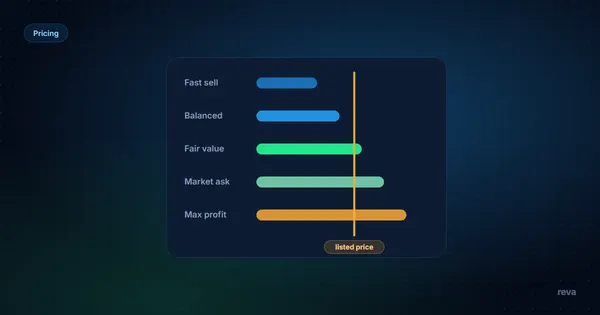
What sold comps are and how to find them on Vinted, OLX and Allegro Lokalnie with no sold filter: match brand, size and condition, and how many you need.
9 min read
Can you see sold prices on Vinted? What the app shows, why 'sold filter' tips conflict, and honest ways to estimate what similar items went for.
9 min read