 reva
revaInventory Management for Resellers
Systems for tracking one-of-a-kind stock from purchase to payout.
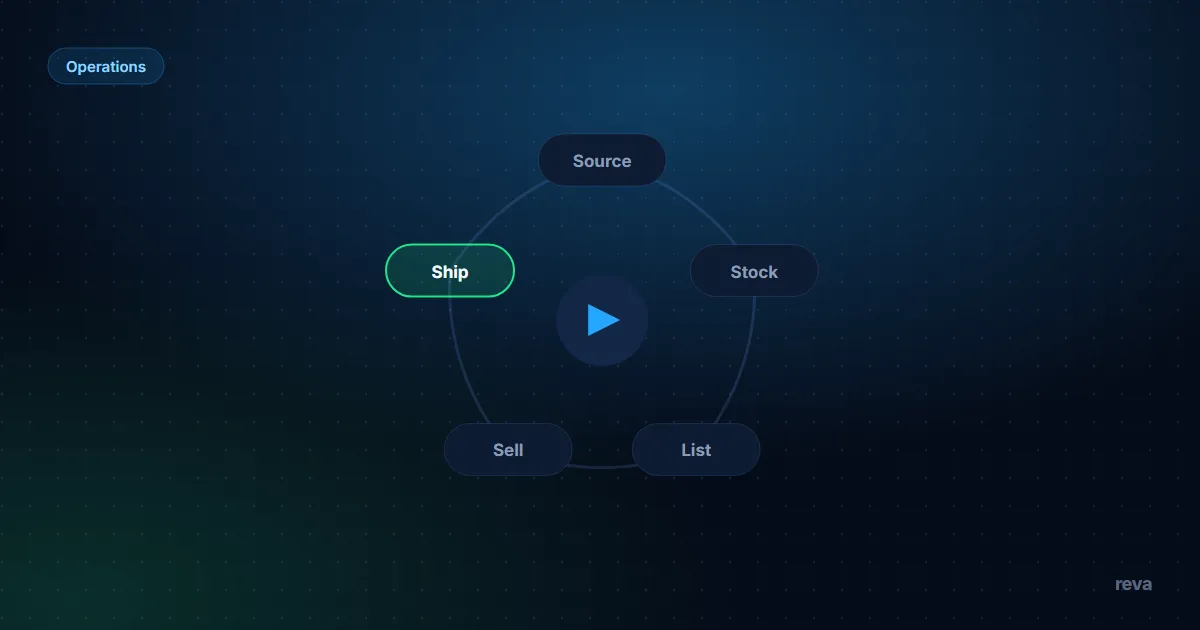
- Track items, not SKUs: one row per physical item, keyed by a code you attach on the day you buy it. Keep the first-listed date even after a relist, or days on market resets to zero.
- Sell-through = items sold ÷ (items at the start + items added). Turnover = cost of items sold ÷ average stock at cost. Set targets from your own past periods, not from outside averages.
- Set aged-stock review points as multiples of your own median days to sell per category. Apply each step within the platform's rules: edit the price on Vinted rather than delete and relist, and on OLX a relist within 14 days counts as a duplicate in free and limited categories.
- Shipping clocks are hard limits: Vinted cancels an order that isn't shipped within 5 business days, and OLX refunds the buyer if you don't hand the parcel to the carrier within 3 working days of accepting.
- In Poland, unregistered activity is capped at 10,813.50 zł of revenue per quarter in 2026 and needs a simplified sales record, so build your sheet to double as that record (general information, not tax advice).
- Why reseller inventory management differs from retail
- What to record for every item
- SKUs, labels and storage at home
- Listing status across marketplaces
- Sell-through rate and inventory turnover for one-off stock
- Days on market and aged-stock rules
- Dead stock: markdowns, bundles and lots
- Shipping deadlines and a packing station
- Returns: getting items back into stock
- Spreadsheet or software: when to switch
- Tax records you will need later
Reseller inventory management means keeping one record per item from the day you buy it to the day the money lands, then using those records to decide what to reprice, bundle or stop buying. Second-hand stock is one-off, so you track individual items, not quantities of a SKU. For a few dozen to a few hundred active items, a spreadsheet with a label code, cost, dates, listing status and sale details is enough.
This guide walks one item through that life: recording and storing it, keeping its status straight across Vinted, OLX and Allegro Lokalnie, measuring how fast stock moves, and deciding when it has waited too long. Each section ends with a link to the page that goes deeper. Marketplace facts were checked on 13 September 2026; every other number is marked as an example.
Why reseller inventory management differs from retail
Retail inventory systems assume many identical units: you count how many of a product are left and reorder when stock runs low. Resale stock breaks those assumptions.
| Retail stock | One-off resale stock | |
|---|---|---|
| Unit of tracking | SKU with a quantity | One physical item |
| Reordering | Buy more of what sells | Nothing to reorder; you source a similar item |
| Cost per unit | Same for every unit | Different for every item, sometimes a share of a lot |
| Condition | New, uniform | Graded per item, with its own flaws |
| Price | Set once per SKU | Set per item from comparable listings |
| Where it is listed | Your shop | Often several marketplaces at once |
| Ageing | Seasonal markdowns per product line | Each item ages on its own clock |
Three consequences follow:
- The record starts at purchase, not at listing. An item you bought but haven't photographed is still cash tied up. If your records start at listing, that cash disappears from view.
- Averages hide single items. A category can look healthy while five items in it haven't moved for months. You need per-item dates, not just totals.
- Status matters more than quantity. The question isn't "how many are left" but "where is this item, and is it still for sale anywhere else".
- 1BuyRecord the cost, date, source and a code for the item
- 2Prepare and storeClean, grade the condition, photograph, bag, tag and put it in a numbered box
- 3ListRecord the marketplaces, the price and the first-listed date
- 4Sell and shipRecord the sale, delist everywhere else and ship before the platform's deadline
- 5PayoutRecord fees and the date the money becomes available
- 6Close or return to stockMark it done, or re-inspect a returned item and list it again
What to record for every item
Record what you need to answer four questions later: what did it cost, where is it, how long has it been waiting, and what did it really earn. Anything else is optional.
Example record for one item, with the reason for each field:
| Field | Example value | Why you need it |
|---|---|---|
| Item code | 2609-014 | Links the tag, the storage box and every listing to one row |
| Description | Levi's 501 jeans, W32 L32 | Lets you search the sheet |
| Category | Jeans | Needed for per-category sell-through and days to sell |
| Condition note | Very good, small mark on back pocket | Matches the photos if a buyer disputes the condition |
| Storage location | Box B3 | Means you can pack it in minutes when it sells |
| Purchase date and source | 2 Sept 2026, second-hand shop | Starts the "days in stock" clock; supports tax records |
| Purchase cost | 25 zł | The base for profit and turnover |
| Other costs | 3 zł cleaning | Belongs to this item's profit |
| First listed | 4 Sept 2026 | Starts the "days listed" clock; never overwrite it |
| Marketplaces | Vinted, OLX | Tells you where to delist after a sale |
| Price history | 119 zł, cut to 99 zł on 24 Sept | Shows which markdown step it is on |
| Status | Listed | Drives your daily to-do list (see the status table below) |
| Sale date, marketplace and price | – | Needed for revenue, days to sell and platform reconciliation |
| Fees and shipping you paid | – | Turns sale price into net profit |
| Shipped and paid-out dates | – | Tells you when the row can close |
Two date fields do most of the work. Days in stock is today minus the purchase date: how long your cash has been tied up. Days listed is today minus the first-listed date: how long buyers have been able to see the item. A relisted item gets a fresh listing with its own date, so keep the first-listed date in your record, or an item that has waited three months looks new.
For lots, split the lot price across the items when you enter them. Example: a 90 zł bag of six tops, where two are clearly better, might be entered as 25 zł each for the two good ones and 10 zł each for the other four. Any split works as long as the parts add up to what you paid and you use the same method every time.
How fees, buyer-paid protection charges and shipping turn a sale price into net profit, marketplace by marketplace, is covered in the reselling profit guide. The reseller inventory and profit tracker spreadsheet has these columns ready, with zł and € fields and fee columns for Polish marketplaces.
SKUs, labels and storage at home
A code only helps if you can get from the code to the item, and back, in seconds. For one-off stock, a plain code (purchase year and month plus a running number, e.g. 2609-014) with a separate location field outlives any scheme that describes the item. The full system — tagging on sorting day, status-based storage, numbered boxes and the monthly three-code audit — is laid out in how to organize reseller inventory at home.
Listing status across marketplaces
Listing one item on Vinted, OLX and Allegro Lokalnie at the same time widens its audience. It also creates the one error an inventory record must prevent: selling the same item twice. A status column with a fixed set of values keeps the row honest.
| Status | Meaning | What happens next |
|---|---|---|
| To list | Coded and stored, not yet online | Photograph and list |
| Listed | Live on one or more marketplaces | Review on your aged-stock schedule |
| Reserved | A buyer has committed but not paid, or an order awaits acceptance | Pause the other listings |
| Sold, to ship | Order confirmed | Delist everywhere else, then pack before the deadline |
| Shipped | Handed to the carrier | Wait for delivery and the claim window |
| Paid out | Money available, no open claim | Close the row |
| Returned | Back with you after a claim or withdrawal | Inspect, then return to stock or write off |
| Written off | Donated, recycled, damaged or lost | Record the reason and the cost |
Decision rule: when a status changes to "Sold, to ship", delist the item from every other marketplace before you start packing. Packing is where interruptions happen.
Platform rules shape how you handle listings:
- Vinted: its Catalogue Rules say a bundle must be labelled as a bundle with one total price, and the items in it cannot also be listed separately. The Terms forbid deleting and re-listing "the same Item multiple times or multiple Items in bulk". Vinted has announced updated Terms taking effect on 5 October 2026 in Germany and France and on 8 October 2026 in the UK, US and Poland. Press coverage of the UK, US and Australia update reports no change to the relisting rules. Check again after those dates.
- OLX: under the Terms effective 27 April 2026, a listing runs for 30 days and must say whether it is a single item, several units or a set. In free and limited categories, only one listing for the same item may be live at a time, and ending a listing and adding the same item again within 14 days counts as a duplicate.
- Allegro Lokalnie: auctions run for 7 days, and the "Kup teraz" and auction sale fee is charged only if the buyer pays within 72 hours (prepaid) or fills in the delivery form (cash on delivery or pickup). Use that same moment as your trigger to change the item's status and pause its other listings.
Auto-delist tools narrow the gap between a sale and the other listings coming down, but they don't close it. On their own help pages, Crosslist says Vinted sales can take up to 30 minutes to detect, Flyp says it searches for new sales every 15 minutes and marks items sold when you log in and are active in your account, and Vendoo's sale detection is in beta and needs your computer turned on and awake. A buyer elsewhere can check out in that window. How to avoid double sales when crosslisting covers the manual routine, what to do when it happens anyway and the cancellation consequences.
Sell-through rate and inventory turnover for one-off stock
Two numbers tell you whether stock is moving. They measure different things, so track both.
Sell-through counts items. For one-offs that means one listing is one item, a relisted piece is still the same item, and a lot sold as one listing is one item. Turnover counts money at cost, so one slow, expensive item weighs more than ten cheap fast ones.
What the numbers tell you to do:
- If one category's sell-through stays well below your blended rate for two periods in a row, stop buying in that category until you have checked its prices and demand.
- If sell-through is high but turnover is low, a few expensive items are holding most of your cash. Look at those first.
- If sell-through jumps after a round of price cuts, check margin for the same period before you celebrate. Underpricing raises sell-through too.
Don't compare yourself with an "average reseller" rate. From outside, a listing that disappears can be a sale, a withdrawal or a relist, so you can't reliably work out another seller's sell-through. Build your targets from your own last three periods of the same length. The sell-through rate definition and calculator covers period choice, relists and category splits. The inventory turnover calculator converts turnover into days and shows how turnover and ROI together decide how much cash you need.
Days on market and aged-stock rules
Aged stock is stock that has waited longer than your own rule allows, and the rule has to come from your own sales. None of the marketplace pages in our research publishes an average time to sell, and the one days-to-sell figure in the search results, a blog post about sneakers, is an unverified claim that we could not trace to measured data.
Build the rule in three steps:
- Measure. For each item sold in a category over recent months, subtract the first-listed date from the sale date. Take the median, the middle value, rather than the average, so one very slow item doesn't distort the figure.
- Set review points as multiples of that median. Write them down per category.
- Attach an action to each review point, so a review ends in a decision, not a shrug.
How much stock to keep in the first place — capital, space and review cadence as one decision, with no magic number — is the neighbouring question, worked through in how much inventory to keep.
Example: your last nine jackets and coats sold after 5, 8, 12, 15, 20, 24, 29, 36 and 51 days listed. The median is 20 days. Using multiples of 20 as review points gives you this schedule:
| Days listed (example, median 20) | Stage | Action |
|---|---|---|
| 0–20 | Fresh | Leave the price alone unless the listing gets almost no views |
| 21–40 | Review | Check views and favourites; fix title and photos, or step down one price level |
| 41–60 | Stale | Step down another level; consider a bundle or a second marketplace |
| 61–80 | Last call | Step down to your lowest planned price, still above break-even |
| Over 80 | Exit | Decide between a lot, another channel or a write-off |
- Listed price
- Break-even after costs
Each markdown step has to fit the platform:
- Vinted: change the price by editing the listing rather than deleting and relisting. During a Bump you can lower the price but not raise it, and the Bump cost stays the same (help page 340).
- OLX: the end of the 30-day listing period is a natural review point. Edit the price rather than ending the listing and adding it again within 14 days.
- Allegro Lokalnie: an auction ends after 7 days, so each unsold auction is a review point before you relist at a lower level.
Record each price change in the price-history field, with the date. After a few months you can see which step items usually sell at in each category, and you can price the next similar item at that step from day one.
How to measure days to sell on Vinted, and how to estimate it for similar listings that left the market, is covered in how long it takes to sell on Vinted. How big each step should be, tied to the price ladder and demand signals, is covered in when to lower your price.
Dead stock: markdowns, bundles and lots
An item that has passed your last review point is dead stock. The question is no longer what it is worth, but which exit returns the most cash for the least time: a Vinted bundle, a declared set on OLX, a lot on Allegro Lokalnie, another marketplace, or donating and writing it off. How to liquidate unsold inventory compares those exits channel by channel and sets out the rule for when the cash is worth more than the item.
Your inventory record has two jobs at this stage.
Keep bundled items traceable. When items go into a bundle or lot, set each one's status to "In bundle" with a shared reference (for example 2610-B1) and end their single listings. On Vinted this is a rule, not just tidiness: items in a bundle cannot also be listed separately.
Split the revenue back to the items when it sells, so per-item profit stays correct. Example: three items that cost 30 zł, 20 zł and 50 zł sell together for 180 zł. Split by cost share, that is 54 zł, 36 zł and 90 zł of revenue. Without the split, one row shows the whole sale and two show nothing, and your category figures go wrong. Items you donate or throw away get the status "Written off" with the reason, so their cost still shows up as a loss.
The cheapest dead stock is the item you never buy. If one category keeps reaching the exit stage in your sheet, set your buying limits for it from what comparable items leave the market at, before you pay.
Shipping deadlines and a packing station
Once an item sells, a platform clock starts. Vinted's help pages (UK and Poland) say an order not shipped within 5 business days is cancelled automatically; you can ask the buyer for 3 or 5 extra business days, and they may refuse. OLX's Terms (§11.8) refund the buyer automatically if you don't confirm the sale within 72 hours of the order, or don't hand the parcel to the carrier within 3 working days of accepting. Miss either clock and the item is back in stock after the other listings have already come down. Shipping deadlines and rules on Vinted, OLX and Allegro Lokalnie sets the three platforms side by side.
Payout closes the row, and it doesn't happen at the moment of sale:
- Vinted (UK help pages): the money shows as "Pending balance" until the order completes. The buyer has 2 days after delivery to complete the order or raise a claim, and the payment arrives within 2 days of completion.
- OLX (Terms §11.7): the payout is ordered when the buyer confirms a conforming item, or 48 hours after pickup or delivery if no claim is filed.
Record the paid-out date separately from the sale date. Until then, the money isn't yours to spend.
- A "sold, to pack" shelf, filled the moment a status changes
- Mailers and boxes in the sizes you use most, within arm's reach
- Tape, scissors, a small scale and a tape measure
- A printer, or a phone with the carrier app, for labels and codes
- A fixed daily cut-off: everything sold before it ships that day
- A photo of each item next to its open parcel before sealing, filed under the item code
- Status set to "Shipped" with the date before the parcel leaves the table
The photo before sealing costs seconds. If a buyer later claims the parcel was empty or the item was different, it is your record of what went into the box.
Returns: getting items back into stock
A return reverses the row: the sale is undone, the item comes back, and it needs a fresh condition check before it goes on sale again. For your stock, the clocks matter most:
- Vinted, private seller (UK help pages): a buyer can't return an item because they changed their mind. After a not-as-described claim, the buyer sends the item back within 5 business days of your request, and you have 2 days after receiving it to inspect before the buyer is refunded.
- OLX, accepted Pakiet Ochronny claim (Annex 8 and help pages): the buyer returns the item through Zwroty OLX at your cost. Returned parcels wait 48 hours at InPost, 72 hours at Orlen Paczka and 7 days at Poczta Polska, so collect on time.
- Allegro business account (allegro.pl, returns sent with Allegro return methods): after a consumer withdraws, the refund goes out automatically 7 calendar days after you physically pick up the return parcel, unless you refund or refuse in the Zwroty tab first.
Whether you have to accept a return at all depends on whether you sell privately or as a business, and biznes.gov.pl says consumer rights, including the 14-day withdrawal right for distance sales, apply to Polish unregistered activity. Do private sellers have to accept returns? separates the two cases. This is general information, not legal advice.
- Set the status to "Returned" the day the return is announced, not the day it arrives
- Collect the parcel within the carrier's pickup window
- Photograph each side of the parcel before opening
- Compare the item with your listing photos and the photo taken before sealing
- Re-grade the condition; if it has changed, update the condition note and photos
- Decide: back to "To list", "Written off", or kept aside while a dispute is open
- Edit or reactivate the existing listing where the platform allows, rather than creating a duplicate
- Reverse the sale in the row: remove the revenue, keep a note of any costs you did not get back
Spreadsheet or software: when to switch
A spreadsheet handles single-marketplace selling at almost any volume a part-timer reaches. Two things usually force a change: crosslisting, where a missed delist becomes a double sale, and the time it takes to update statuses by hand.
Decision rules:
- Stay on a spreadsheet if each item is live on one marketplace, you update statuses once a day, and your random three-item check keeps passing.
- Consider software if you have had a double sale, or you spend more time updating rows than listing new items.
- Before paying, check support for your marketplaces and country. Crosslist says it works in the US, UK, Canada and Australia, and Flyp's help centre says its crosslister is available only in the USA (that FAQ is undated). None of the crosslisters in our research lists OLX or Allegro Lokalnie among its marketplaces.
| Spreadsheet | Vendoo | List Perfectly | Flyp Reseller Tools | Crosslist | reva | |
|---|---|---|---|---|---|---|
| Per-item inventory records | Yesyou build the columns | Yesinventory management, custom labels | Yescatalogue, SKU generator, QR labels | Yesunlimited inventory, duplicate detection | Yestags, filters, linked listings | In buildStock module |
| Sale detection and auto-delist | Nomanual | Partlybeta; Vinted not in its list; computer must stay on | PartlyPro Plus only; Vinted not in its Jan 2025 list | Partlysearches every 15 min; marks sold when you are active | PartlyGold and Diamond; Vinted up to 30 min | Nonot available today |
| Stale-listing flags | Partlya days-listed formula | YesStale Listing Warning System, named in its mobile help as not in the app | YesStale Listings on Pro Plus | Not stated | Not stated | Nonot available today |
| CSV export | Yes | Yesnot in the mobile app | YesBusiness plan and up | Partlysales data export | YesGold and Diamond | Nonot available today |
| OLX or Allegro Lokalnie listings | Yesany marketplace | Not statednot in its marketplace list | Not statednot in its marketplace list | Not statednot in its marketplace list | Not statednot in its marketplace list | PartlyScout and Buy read both; Stock in build |
What each option does well, on its own pages: List Perfectly offers an SKU generator and QR inventory labels, Vendoo includes custom labels and CSV download, Flyp sends sale price, shipping, fees and cost of goods to its analytics, and Crosslist's Gold and Diamond plans include CSV import and export alongside auto-delist.
Tax records you will need later
Your inventory sheet is also the raw material for tax and platform reporting. What follows is general information from official Polish and platform pages, not tax advice. Confirm your own situation with a tax adviser.
| Rule | What it means for your records | Source (checked 13 Sept 2026) |
|---|---|---|
| Unregistered activity (działalność nierejestrowana): revenue may not exceed 225% of the minimum wage in any quarter, which is 10,813.50 zł per quarter from 1 January 2026. It is open only to people with no business activity in the previous 60 months | Keep a revenue total per quarter and watch it against the limit | biznes.gov.pl |
| Unregistered activity requires a simplified sales record and an annual PIT-36 on the tax scale, with costs deductible | Sale date, amount and item cost per row give you most of that record | biznes.gov.pl |
| If you exceed the limit, you must register in CEIDG within 7 days | Check the quarterly total at least monthly, not at quarter end | biznes.gov.pl |
| Selling private items held for more than 6 months (counted from the end of the month of purchase), occasionally, is not subject to income tax; sales made as a business are taxable however long you held the item | Keep purchase dates, and keep stock you bought to resell separate from your own belongings | gov.pl (Ministry of Finance) |
| DAC7: a platform reports a seller who made at least 30 sales or was paid more than the equivalent of €2,000 in a calendar year. Reporting is not a new tax | Count sales per platform per calendar year so the platform's report doesn't surprise you | gov.pl; Vinted, Allegro DAC7 pages |
Platform details that change how you count:
- Allegro combines all accounts of the same seller across Allegro and Allegro Lokalnie when counting towards the DAC7 threshold, so one count covers both.
- Vinted sends the seller a copy of the data it reports, which you can check against your own yearly totals. Its Polish, French and German DAC7 pages say that if you don't submit the DAC7 form, you can't sell or access your Vinted Wallet until you do.
- OLX withholds payouts if a seller doesn't provide the required DAC7 data within 60 days after at least 2 reminders.
Account type matters as stock grows. Vinted's help page on commercial selling, in its Polish version, says Vinted Pro is not open to Polish businesses, and among the signs of commercial activity on a standard account it lists the number of completed orders, revenue, and many new or tagged items. On Allegro Lokalnie, only regular accounts can publish listings: business accounts can buy but not sell.
Keep proof of purchase cost for every row where you can: a receipt, a screenshot of the listing you bought from, or a bank transfer reference. Reselling in Poland without a registered business explains the limit and the difference between private items and buying to resell, and DAC7 for resellers compares how each marketplace applies the reporting rules.
Frequently asked questions
What is the best way to track reselling inventory?
How long should I keep an item before marking it down?
What should an inventory spreadsheet include?
How do I label one-off items?
Do I need inventory software?
Sources
- Vinted UK Help: How shipping works (help 753) checked 13 Sept 2026
- Vinted Poland Help: shipping (help 753) checked 13 Sept 2026
- Vinted UK Help: Vinted Balance, how it works checked 13 Sept 2026
- Vinted UK Help: Returning an item checked 13 Sept 2026
- Vinted UK Help: Item is significantly not as described checked 13 Sept 2026
- Vinted UK Catalogue Rules checked 13 Sept 2026
- Vinted UK Help: What is an item Bump checked 13 Sept 2026
- Vinted UK Terms and Conditions (version in force, with update notice) checked 13 Sept 2026
- Vinted Poland Terms (version in force, with update notice) checked 13 Sept 2026
- Vinted Poland Help: Commercial selling (help 1120) checked 13 Sept 2026
- Vinted Poland: DAC7 checked 13 Sept 2026
- Value Added Resource: Vinted US, UK and Australia terms update, October 2026 checked 13 Sept 2026
- OLX.pl Terms (Regulamin), effective 27 April 2026 checked 13 Sept 2026
- OLX.pl Annex 8: Pakiet Ochronny checked 13 Sept 2026
- OLX.pl Help: Pakiet Ochronny deadlines checked 13 Sept 2026
- Allegro Help: Fees on Allegro Lokalnie checked 13 Sept 2026
- Allegro Lokalnie: Sprzedaj teraz checked 13 Sept 2026
- Allegro Help: Allegro Smart! on Allegro Lokalnie checked 13 Sept 2026
- Allegro Help: Automatic refunds after withdrawal, FAQ checked 13 Sept 2026
- Allegro Help: Seller data collected and reported under DAC7 checked 13 Sept 2026
- biznes.gov.pl: Działalność nierejestrowana (unregistered activity) checked 13 Sept 2026
- gov.pl Ministry of Finance: Co warto wiedzieć o dyrektywie DAC7 checked 13 Sept 2026
- Vendoo pricing checked 13 Sept 2026
- Vendoo Help: Why aren't my sales being detected? checked 13 Sept 2026
- Vendoo Help: Which marketplaces does Vendoo support? checked 13 Sept 2026
- Vendoo Help: Can I use Vendoo from my phone or tablet? checked 13 Sept 2026
- List Perfectly pricing checked 13 Sept 2026
- List Perfectly: The ultimate guide to Auto Delist checked 13 Sept 2026
- Flyp Help: Auto Delist, Auto-mark as Sold and Delist checked 13 Sept 2026
- Flyp Help: Why Flyp Reseller Tools checked 13 Sept 2026
- Flyp Help: Does the crosslister work outside the US? checked 13 Sept 2026
- Crosslist pricing checked 13 Sept 2026
- Crosslist Docs: Autodelist checked 13 Sept 2026
- Crosslist: Marketplaces checked 13 Sept 2026
Start with reva
One place to find underpriced items, check their market value and act before someone else does.
reva estimates prices from public listings. Estimates, not guarantees.Keep reading

Sell-through rate is the share of listed items that sell in a period: the formula, a free calculator, a reseller example and how it differs from turnover.
6 min read
Exits for resale stock that won't sell after markdowns: bundles, lots on OLX and Allegro Lokalnie, moving marketplace, donating and a rule for cutting losses.
8 min read
Private sellers usually needn't accept change-of-mind returns, but not-as-described claims still apply. How Vinted, OLX, Allegro and Lokalnie handle it.
8 min read