 reva
revaHow to Handle Lowball Offers
Decide your floor before the offer arrives, and most of the anger disappears.
- Your floor is the higher of the fast-sell level and your break-even — compute it before you list and write it where you will see it.
- Counter with numbers, not lectures: first counter at fair value, second at the floor, never below it.
- On Vinted, private selling is free and the buyer pays the protection fee; on OLX delivery, the buyer pays Pakiet Ochronny — don't discount for fees that never touch your payout.
- Several lowballs far below your ask in a short window is market feedback: re-check your comparables before you re-check your temper.
- Stop replying when the number stops moving; the floor line — a price plus a deadline — ends the thread politely.
A lowball offer is an opening bid far below your ask — say 40 zł on a 120 zł listing — and it lands much better when the answer was already written. If you are working out how to respond to lowball offers in the moment, you have skipped the only step that matters: the floor you computed before you listed. With that number on paper, every reply becomes arithmetic — counter, hold, or pass. This page sets the floor, gives three replies that keep buyers talking, and covers the case where the lowball is really information about your price.
Platform facts below were checked on 13 September 2026. The offers, prices and message drafts are worked examples.
Set your offer floor before you list, not when the message arrives
Two numbers decide every offer, and both exist before the first message arrives:
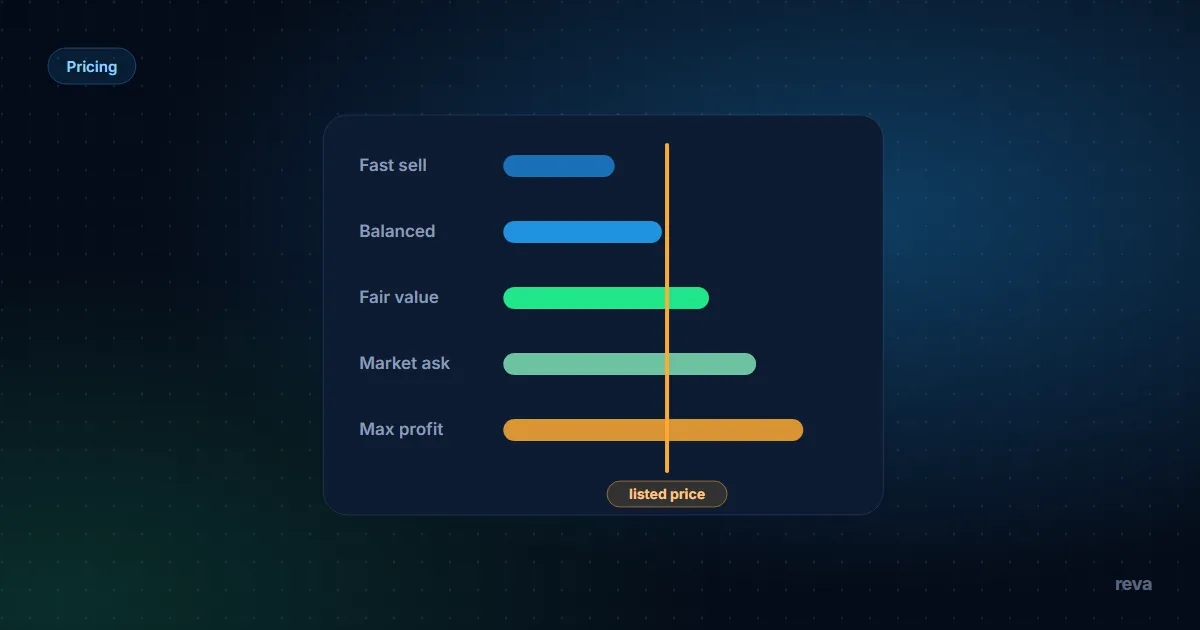
- The fast-sell level — near the cheapest quarter of matched, live comparable asks. The price ladder builds all five levels and where the evidence for each comes from.
- Your break-even — what the item cost you plus everything you pay to sell it. The break-even calculator works it backwards from your numbers.
Example: a Levi's denim jacket you bought for 55 zł. Market ask 120 zł, fair value 105 zł, balanced 95 zł, fast sell 90 zł. Break-even 60 zł. The floor is the higher of 90 and 60: 90 zł. Write it on the listing draft or in your sheet before you publish. From that moment, any offer at or above 90 zł is a customer, anything below is a pass or a lesson — and the next two sections tell you which.
Three replies that keep a buyer in the conversation
Each reply answers a different situation:
- Counter with a number. Offer 40 zł on the jacket listed at 120 zł: "I can do 105 zł." One sentence, one figure, no lecture about what you paid or how hard it was to find. Buyers negotiate with numbers; essays get left on read.
- Bridge with something cheap for you. "115 zł for the jacket and the scarf together." A bundle adds value that costs you little and lifts the total without breaking your per-item floor.
- State the floor and close. "90 zł is my lowest — say yes and I'll post it today." This is the second-round reply, used after the buyer has countered once. A firm number plus a deadline lets a budget-capped buyer say yes instead of drifting away.
When a lowball is information, not an insult
One low offer is one buyer's budget. A pattern is the market repricing your listing:
- Two or three independent offers at roughly half your ask within a fortnight: re-run your comparables before replying to anyone. Cheaper matched listings may have appeared since you priced, and the two-minute check in the resale pricing guide takes less time than a bad mood.
- Offers in the first hours after listing usually mean the buyer is comparing you against something they just saw. Check where your ask now sits in the search results before answering.
- Silence after your counter is data too. A buyer who disappears at 90 zł was never going past 70, and you have lost nothing but a minute.
Declining silently is allowed and costs nothing. A short reply costs half a minute and occasionally surfaces a budget you can work with; it never obliges you to discount.
Counter-offer maths: worked example
Two numbers set the shape of the whole negotiation: your floor (90 zł) and your fair-value level (105 zł).
- First counter: fair value, 105 zł. It is defensible — that is where comparable jackets left the market — and it leaves two steps of room below.
- Second counter: the floor, 90 zł, with the close line. Below the floor you do not go; going below it is an exit decision, not a tactic.
- 1Offer arrivesCompare it to the floor you wrote before listing — 90 zł on the jacket. The number decides the reply, not the tone.
- 2At or above the floorAccept, or counter once at your fair-value level if you can wait a few days for the difference.
- 3Below the floor, first roundCounter at fair value: one sentence, one number, no lecture.
- 4Buyer counters, still below the floorThe floor line: '90 zł is my lowest — say yes and I'll post today.'
- 5Accepted at or above the floorPost it, mark it sold, log the days it took and the gap between ask and floor.
- 6Declined at the floorStop replying. The listing stays up for the buyer who pays the ask.
The fee arithmetic is friendlier than most sellers assume, and it matters for how you counter. Vinted's price list and Our platform page (checked 13 September 2026) put no commission on private sales — selling is free, and the Buyer Protection fee is added for the buyer at checkout. On OLX delivery orders, the Pakiet Ochronny is likewise the buyer's cost, shown as a separate line in the listing. A 90 zł sale pays you 90 zł. Don't shave a counter "for fees" that never reach your payout. At the time of writing (September 2026), Vinted's updated Terms — effective 5 October 2026 in DE/FR and 8 October 2026 in the UK, US and PL — rename that buyer charge the "Vinted fee"; check the live price list after those dates.
And what a discount actually buys: dropping 105 zł to 90 zł is a 14% price cut for a maybe-two-weeks-faster sale. Sometimes that trade is right — the markdown schedule in when to lower a price makes it a dated decision instead of a reflex.
Auto-decline settings and when they help
None of the Vinted help pages or terms we read on 13 September 2026 documents an automatic offer-decline setting, so treat any toggle you find in your app as unverified in its behaviour. The method here does not need it. An auto-decline is only a floor written as a percentage of the ask, and that is its flaw: your floor is a zł amount per item. 90 zł on a 120 zł ask is 75% of the ask; 90 zł on a 300 zł ask is 30%. A percentage rule that fits one listing misfires on the next.
Where your marketplace does offer saved replies, paste the three replies from above in verbatim. That is the useful kind of automation — it speeds the response without replacing the judgement, because the numbers in the replies came from your floor, not from a default.
When to stop replying
Three stop rules:
- The number stopped moving. Two rounds without the buyer's figure rising toward your floor: send the floor line once and let it sit.
- The argument stopped being about the item. "My mate sells these cheaper" after you have cited comparables is not a counter; it is your cue to stop typing.
- The offer sits below half your floor. 40 zł against a 90 zł floor: decline without counter-offering. A buyer that far from your minimum is shopping in a different shop.
Your time has a price too. A 90 zł flip does not deserve an hour of messages: two considered replies, then the floor line, then silence — and the listing stays up for the buyer who was always going to pay the ask. If low offers keep arriving across many listings, the pricing is the real problem: pricing for offers shows how to set an ask with negotiation room built in, and pricing on Vinted covers that platform's specific habits.
Related guides
Frequently asked questions
Should I ignore lowball offers?
How do I set a minimum offer price?
Is a low offer rude or just negotiation?
Do automatic declines put buyers off?
Sources
- Vinted UK price list (no seller commission; buyer fee added at checkout) checked 13 Sept 2026
- Vinted UK: Our platform checked 13 Sept 2026
- OLX.pl Terms (Regulamin), effective 27 April 2026 (Pakiet Ochronny paid by the buyer; payout §11.7) checked 13 Sept 2026
- Value Added Resource: Vinted Europe terms update, October 2026 checked 13 Sept 2026
Analyze an item with reva
Open any find and see its five-level price ladder, demand score and price confidence, built from comparable items that left the market. Estimates, not guarantees.
reva estimates prices from public listings. Estimates, not guarantees.Keep reading

How to price used items for resale: comps from sold and live listings, condition, price levels from fast sale to max profit, markdowns, offers and bundles.
21 min read
Five price levels, from fast sell to max profit, what each is based on and when to choose it depending on cash needs, demand and how long you can wait.
8 min read
Find the lowest sale price that covers what you paid, marketplace fees and shipping. Free break-even calculator for resellers deciding how far to mark down.
7 min read