 reva
revaHow to Resell LEGO
Set numbers, completeness and condition decide the price before the theme does.

- The set number, not the theme, is the price key: it is printed on the box front, on every booklet cover and on the barcode sticker, and it is the thing you check before you buy.
- Grade completeness in four bands — complete with box and instructions, complete, incomplete with a written missing list, or bulk by weight — and prove each band with photos.
- Sealed and used sets are different markets: price a sealed box only from sealed comparables, and a used set from comparables that left the market.
- Sum the parts before you bundle or break a lot; for common sets, completeness is usually worth more than the pieces are apart.
- The buy price decides the deal: in the worked example, a fast-sell plan fails at any all-in cost above roughly 300 zł against a 370 zł fast-sell level.
- Why LEGO prices are set-specific, not theme-wide
- Reading a listing in 60 seconds: set number, minifigs, box, instructions
- Completeness grading you can defend to a buyer
- Sealed vs used: different markets, different maths
- Pricing from comparables: a worked example in zł and €
- When LEGO is not worth buying to resell
- Storage and lot-breaking decisions
- Related guides
How to resell LEGO comes down to three lookups: the exact set number, an honest completeness grade, and comparables for that set — not for its theme. The set number is the key to everything else: what should be in the box, which minifigures belong to it, and what the set has left the market at. Get those three right and pricing turns into arithmetic; get them wrong and you are guessing from a theme name.
This page walks the full method: a 60-second listing triage, completeness grading you can defend to a buyer, sealed vs used maths, a worked pricing example in zł and €, and the points where LEGO is not worth buying at all. The pricing ladder follows the resale pricing guide. Every number below is a worked example.
Why LEGO prices are set-specific, not theme-wide
Two sets from the same theme, the same year and a similar box size can leave the market at very different prices, because each set number is its own small market with its own completists. A licensed display set with sought-after minifigures can hold value for years; a similar-sized generic builder can sell for a fraction of it.
Example: say two mid-2010s sets each cost 300 zł new. One became a sought-after display piece; the other was produced in huge volume and stays easy to find used. Over the past month the first might leave the market around 250–350 zł and the second around 80–120 zł. Nothing about the shared theme told you that — the set number did.
Decision rule: never buy "LEGO". Buy a set number at a price. When you stand in front of a bin at a market, the number is what you look up on your phone. Whether the theme around it currently has enough buyers is a separate question — how to check resale demand covers the search.
Minifigures deserve their own line in your notes. Example: three figures from a sought-after series can outprice the building they came from, which is why the count in your triage matters more than the brick weight.
Reading a listing in 60 seconds: set number, minifigs, box, instructions
The fastest way to judge a LEGO listing is a fixed routine. Run it every time and you stop overpaying for boxes of grey bricks.
- 1Find the set numberBox front near the logo, booklet cover, or the barcode sticker on the back
- 2Confirm contentsLEGO's official instructions search turns the number into a model, parts and minifigure list
- 3Count minifiguresEach named figure checked against the listing photos
- 4Check box and bookletsPresent, damaged, or gone
- 5Scan for stickers and fadingStickers applied or spare sheet; sun-faded bricks
Where the number hides: the front of the box usually carries it near the set name, every instruction booklet shows it on the cover, and the barcode sticker on the back repeats it. If the seller shows no number, ask for a booklet photo — most sellers can find one. The number matters because LEGO's own building instructions search turns it into a parts and minifigure list you can hold against the photos in front of you.
Two details are worth 60 extra seconds:
- Minifigures. Named or exclusive figures are the parts collectors search for. Count them in the photos; a set missing its main minifigures can be worth less than the sum of its bricks.
- Stickers. An unapplied sticker sheet keeps its value; applied and peeling stickers push the set down a completeness band.
If the photos cannot answer these five questions, treat the listing as unsorted bulk until proven otherwise.
Completeness grading you can defend to a buyer
Buyers argue about condition when the seller's words are vague. Fix that with four bands and evidence for each:
| Band | What it means | Your evidence in the listing |
|---|---|---|
| Complete, box and instructions | All pieces, all minifigures, booklets and the box | Photo of the built set or booklets, plus the box |
| Complete | All pieces and minifigures, no box or booklets | Photo of the spread of parts; state that you checked against the instructions |
| Incomplete, listed | Known missing pieces, written into the description | Photo of the gaps, or a written missing list |
| Bulk by weight | Unsorted or mixed bricks, no completeness claim | A scale photo showing the weight |
State the band in the first line of the description, then the evidence. A set graded "complete" that arrives missing a minifigure becomes a claim, so grade only what you have verified against the instructions — not against memory. Clean before you grade: lukewarm water for loose bricks (never hot, which can warp pieces), air-dry, and photograph after cleaning so the buyer sees the state you are actually selling.
Decision rule: if you cannot verify completeness in the time the price difference justifies, sell it in a lower band. Over-graded sets cost more in returns and reputation than they gain in the ask. The same logic in other categories is in how condition changes resale price.
Sealed vs used: different markets, different maths
A sealed box and an opened one can share a number and still not share a market. Sealed pricing is anchored by collectors and by scarcity: once a set is retired from production, sealed stock only shrinks. Used pricing is anchored by people who intend to build.
- Sealed. Comps are other sealed boxes of the same set, box condition included — shelf wear on a sealed box is a real discount. The maths includes time: capital parked in a sealed box may wait months for the buyer who wants it.
- Used. Comps are sets that left the market complete, graded the way the section above describes. Your work — sorting, cleaning, photographing, grading — is what earns the margin.
Decision rule: never price a sealed box from used exits, and never price a used set from sealed asks. A sealed ask carries scarcity value that a buyer of a used set will not pay.
Example: a retired modular building might ask 1,200 zł sealed while complete, built copies leave the market near 700 zł. Neither number is wrong; they answer different buyers. Mixing the two lists is how a listing sits unsold for months.
Buying new sets at retail to hold sealed is its own sourcing strategy with its own risks; the general method is in the product sourcing guide.
Pricing from comparables: a worked example in zł and €
Everything before this section existed to make this one short. Once the set is identified and graded, price it like any comparable-driven item: find comps that match the set number and your completeness band, then read two lists — live asks, and the last prices of comparable listings that left the market. One filter on the exits: drop any listing that disappeared and reappeared with the same photos. It never left the market; it is a price buyers walked away from.
Worked example (zł). Say you are looking at a 2,000-piece set, complete with box and instructions. Over two weeks you watch the market: five comparable complete sets leave the market at 340, 360, 380, 400 and 420 zł — median 380 zł. Live asks run from 350 to 470 zł with a median near 420 zł, and the cheapest quarter of asks ends around 370 zł.
The seller wants 450 zł. That sits above fair value and below the max profit cap, so it can work only if your demand check shows buyers paying at that level. Your buy price decides the rest: at 250 zł all-in, the fast-sell route of 370 zł leaves roughly 120 zł before packaging and travel; at 380 zł all-in the same route doesn't even cover the buy.
The same maths in € looks identical with different digits: say a mid-sized set leaves the market at €75, 80, 85, 90 and 100 on a euro site — median €85 — while asks cluster near €95. The ladder reads €80 / 82 / 85 / 95 / 106. The currency changes; the method does not. Used LEGO prices reward this discipline everywhere.
When LEGO is not worth buying to resell
Pass on a purchase when any of these is true:
- The ask sits at or above fair value. With no gap between the buy price and what the market already pays, packaging and travel push the deal negative. In the worked example, a buy of 300 zł all-in leaves only about 70 zł of the fast-sell gap (370 − 300) — packaging and travel can consume that, which is why the fast-sell plan fails at buys much above 300 zł.
- The set is incomplete and the missing parts are the valuable ones. A set missing its main minifigures is bulk plus a search project.
- You cannot identify the set. Unidentified bricks are bulk by weight, and bulk prices rarely reward driving across town. Say an 8 kg unsorted lot is offered at 200 zł. If bulk in your area clears at, for example, 20–30 zł per kilo, the lot is worth roughly 160–240 zł before your sorting hours — the margin is an afternoon of your life.
- Demand is thin. Oversized oddities and promotional tie-in sets often have a handful of searchers. Few comps and few exits mean low confidence: skip it, or plan on fast sell.
- The plan needs a date you cannot name. Gift-season sets move on a calendar you do not control. If your cash flow needs an exit by a month, a buy that depends on a December buyer is not a buy.
Saying no quickly is a sourcing skill in itself; the full framework is in how to evaluate a resale deal.
Storage and lot-breaking decisions
LEGO stores well but not anywhere: sunlight fades colours, heat can warp thin pieces, and smoke or damp settles into the plastic and stays. Boxes stack; labelled tubs beat sacks; a dry, smoke-free room is part of your margin. A smell you stopped noticing is the first thing the buyer notices.
Lot-breaking — splitting one set into minifigures, bricks and boxes — is a maths problem, not a philosophy:
Example: the 2,000-piece set above, bought for 250 zł. Intact it prices around 380 zł at fair value. Broken up, say its 3 minifigures sell near 30 zł each (90 zł), the empty box and booklets near 60 zł to someone completing their own set, and the remaining bricks as 1.6 kg of clean sorted parts at, for example, 40–60 zł per kilo (roughly 65–95 zł, over a slower sale). Parts total: roughly 215–245 zł — less than the complete set, and three listings instead of one.
That is the usual answer for common sets: breaking them up loses the completeness premium. The exceptions:
- The set is already missing a key minifigure, so the premium is gone anyway.
- The parts are worth more than the whole — sought-after figures, or bricks in colours the bulk market wants — and your comps prove it.
- The box is destroyed but everything else is there, and box-and-booklet buyers exist for that set.
Bundle and lot decisions have their own page: pricing bundles and lots.
Related guides
Frequently asked questions
How do I find out what set a box of LEGO belongs to?
Do incomplete LEGO sets sell?
Is it better to sell LEGO as one lot or as separate sets?
Does the box change the price that much?
Is LEGO worth reselling at all?
Sources
Analyze an item with reva
Open any find and see its five-level price ladder, demand score and price confidence, built from comparable items that left the market. Estimates, not guarantees.
reva estimates prices from public listings. Estimates, not guarantees.Keep reading

How to price used items for resale: comps from sold and live listings, condition, price levels from fast sale to max profit, markdowns, offers and bundles.
21 min read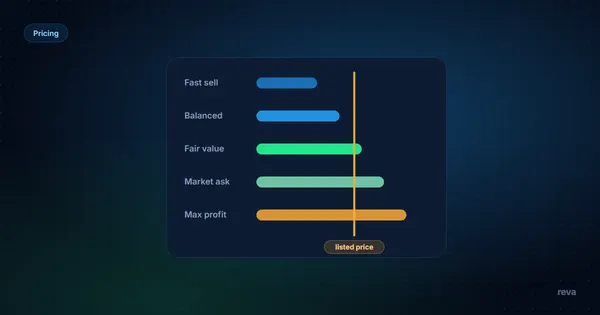
What sold comps are and how to find them on Vinted, OLX and Allegro Lokalnie with no sold filter: match brand, size and condition, and how many you need.
9 min read
Where resellers find stock and how to judge it: online listings, second-hand shops, bales, alerts, buying rules, demand checks and fake detection.
25 min read